Systemise production
The Toyota Production System joins jidoka, which stops defects at source, with Just-in-Time flow.
Toyota City, Japan · est. 1937
A mass-production company with a small, sharply defined collector canon.
Curated entry points
Three cars that explain the manufacturer: its origins, its engineering peak and the shape of its modern ambition.
Complete catalogue
1 models · 1 families
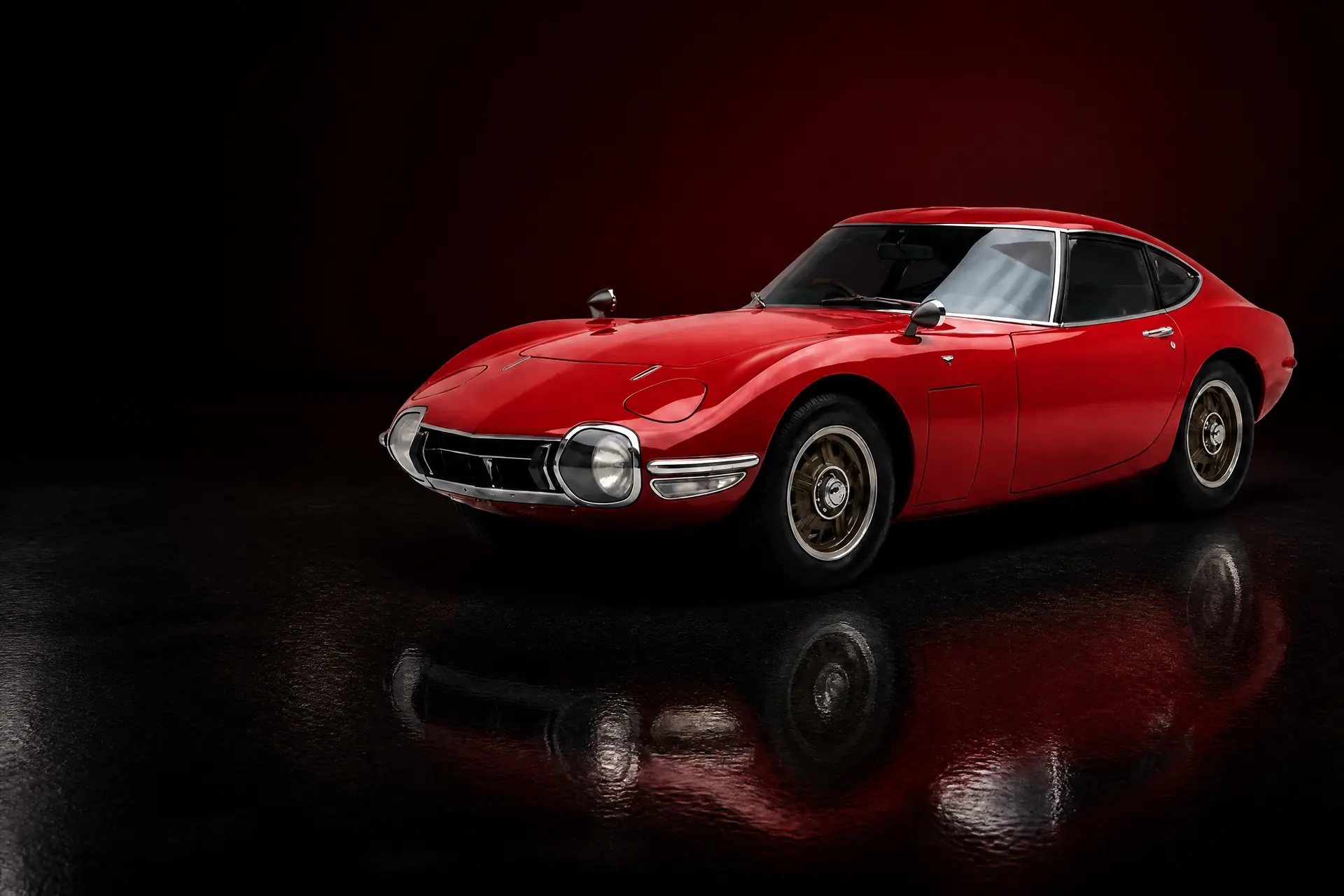
The Yamaha-built twin-cam GT that founded Japanese car collecting — 351 examples, Bond provenance, record-setting pedigree.
The house
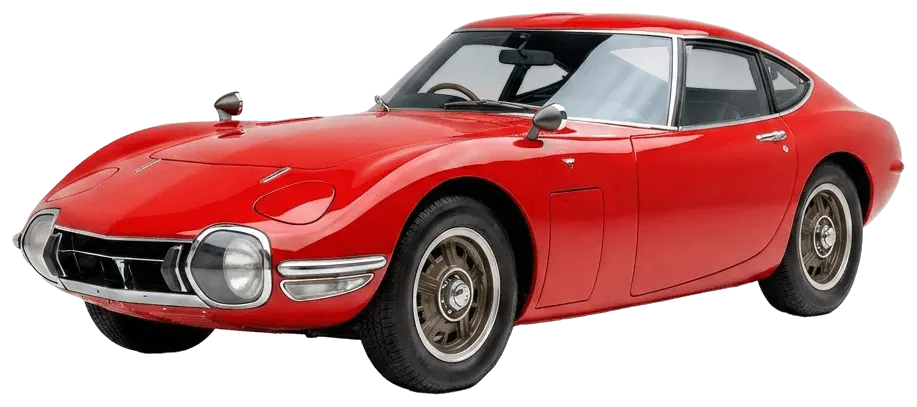
In 1965 Toyota set out to prove Japan could build a world-class GT. With Yamaha engineering the twin-cam straight-six and crafting the rosewood dashboard, the 2000GT emerged in 1967 as Japan’s first supercar.
It set FIA speed records, ran at Le Mans, and starred — roofless, because Sean Connery didn’t fit — in "You Only Live Twice". Just 351 were built, most in left-hand drive for an America that wasn’t ready.
For decades it was a curiosity; now it is the cornerstone of Japanese car collecting, the first Japanese car to clear a million dollars at auction and the benchmark every JDM collectible is measured against.
Selected milestones
1933
The Automotive Division opens
Toyoda Automatic Loom Works creates a dedicated division to develop and manufacture motor vehicles.
1937
Toyota Motor Co. is established
The automotive operation becomes a separate company under the Toyota name.
1955
The Crown enters production
Toyota launches a passenger car developed and manufactured entirely with Japanese technology.
1965
The 2000GT prototype is shown
The Toyota-Yamaha sports-car programme reaches the public at the Tokyo Motor Show.
1967
The 2000GT goes on sale
Production begins in May, bringing a DOHC six, independent suspension and four-wheel disc brakes into Toyota's road-car catalogue.
1997
Prius reaches series production
Toyota launches the first mass-produced hybrid passenger car in Japan.
2020
Heritage parts return
Toyota adds the 2000GT to the GR Heritage Parts programme, reproducing transmission and differential components for owners.
What defines Toyota
The Toyota Production System joins jidoka, which stops defects at source, with Just-in-Time flow.
The Prius moved Toyota's hybrid system from development into mass production in 1997.
The GR Heritage Parts programme reproduces selected factory components for cars including the 2000GT.
The mark
July 1936: the loom works’ young automobile department ran a public competition for a new mark, and 27,000 entries arrived from across Japan. The winner spelled the family name a new way — トヨタ, Toyota, not Toyoda: eight katakana strokes instead of ten, and eight is the lucky number. The company changed its name to match the logo.
For half a century the katakana circle served Japan while plain wordmarks went abroad. The three ellipses came in October 1989, for the fiftieth anniversary: two hearts — the customer’s and the company’s — overlapping in a T, drawn so that every letter of TOYOTA can be traced inside the ovals.

1935–1936
The TOYODA diamond — the family name on the first trucks, gone within a year.

1936–1989
The contest winner: katakana in a circle, eight lucky strokes.
1958–1969
Serif TOYOTA for export — the wordmark that followed the Crown to America.

1978–
The red sans wordmark — it still rides beside the emblem today.
1989–
The fiftieth-anniversary ellipses: every letter of TOYOTA hidden in three ovals.