500 K

The master car

Three hundred and forty-two supercharged straight-eight chassis in three years, each bodied to order by Sindelfingen's Sonderwagenbau — the 500 K was the grandest German car of its age, and The Autocar called the open car 'a master car, for the very few'. The Spezial-Roadster on top of the range cost as much as a house.

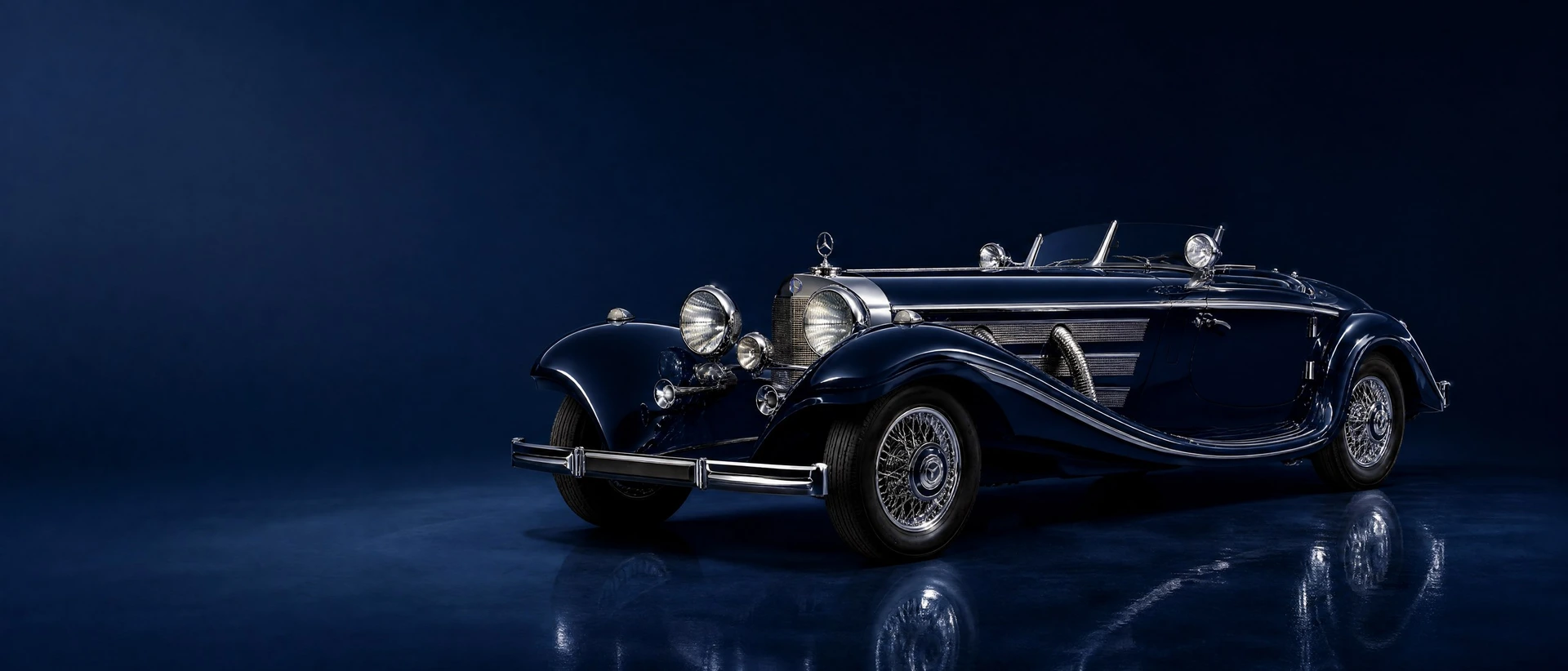
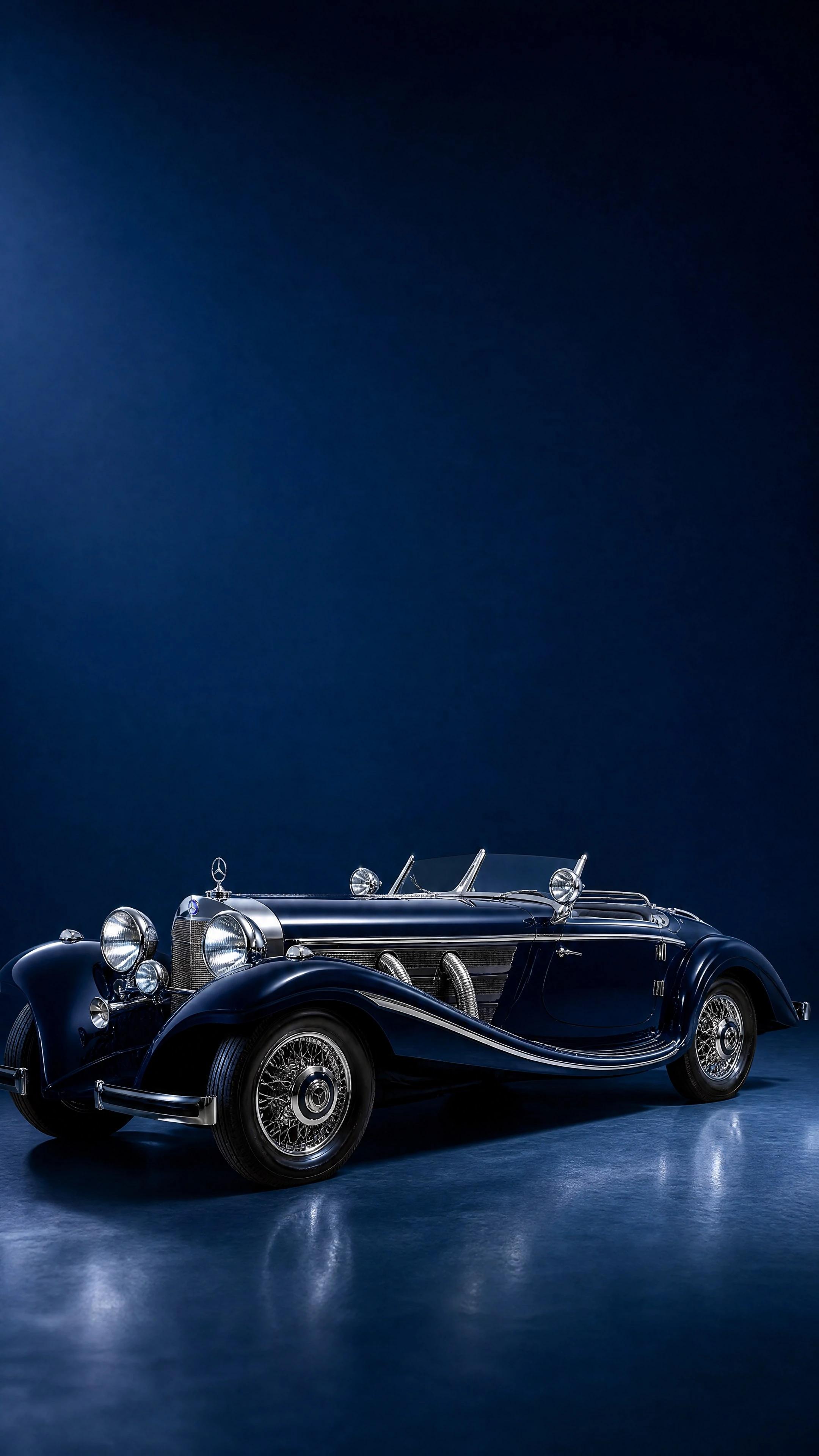
A midnight-blue Mercedes-Benz 500 K Spezial-Roadster with chrome exhaust pipes, front three-quarter view on a deep midnight-blue field in soft evening light

Market value · road

$850K$5.9M

Typical $3.4M · 5 sales · -13% vs ’23–’24

$723K$6.3M
Open Market & Price

Market value · road

$850K$5.9M

Typical $3.4M · 5 sales · -13% vs ’23–’24

$723K$6.3M
’11’26
Market history · in the terminal
Open Market & Price
Power
100 / 160 PS (M 24 I straight-eight · blower on kickdown)
Built
342 (factory count · Bonhams tallies 354)
Top speed
160 km/h (factory · Bonhams quotes near 177)
Gearbox
Schnellgang (clutchless overdrive fourth)
Price then
RM 28'000 (Spezial-Roadster — a prime house in town)
Record
$5.34M (Spezial-Roadster · Monterey 2025)

Market & Price

The price and the proof

A terminal for one car: the model curve over the documented record, the benchmarks it is measured against, and the instruments that read it.

Records: 8 documented road sales on file · 2011–2026; estimate band $850K–$5.9M · good road cars. recorded sale prices · mixed hammer and premium-inclusive basis.

HCN:500KLive model
$2'239'420-56.6% · 12M
$1M$2M$5M20182020202220242026CovidRate shockS&P 500
Model curve · anchored to 7 documented salesnot investment advice
The readouts · model figures against the benchmarks7 documented anchors · last sale 6 mo ago

Compound annual growth

WindowThis car*S&P 500Gold
1Y-56.6%+18.8%+21.9%
5Y-2.9%+11.4%+17.6%
10Y+1.9%+13.3%+11.8%

*Modeled price CAGR · S&P is a price index, no dividends

Deepest drawdown · model window

This car*-83.7%Sep 2016Jan 2026 · not recovered
S&P 500-20.3%Dec 2021Oct 2022 · recovered Dec 2023
Gold-39.3%Sep 2011Dec 2015 · recovered Jul 2020

Forecast ladder · model quantiles

HorizonP10P50P90
+6M$1.8M$2.2M$2.7M
+12M$1.7M$2.2M$2.9M
+24M$1.5M$2.2M$3.2M

Median path with the 10th and 90th percentile · not investment advice

Transaction ledger · documented sales

8 of 8 recorded sales · shown in USD · recorded currency in each record

Authenticity is the entire game: workshops have rebodied saloons into 'Special Roadsters' since the 1950s, and those cars trade at $1.2–2.0 million against $5 million-plus for Sindelfingen originals. Mercedes-Benz Classic authenticates. The 2026 season showed softness — a Roadster hammered 54 per cent below its low estimate at Mecum Monterey.

Price range · road · openConfidence · lowThis is a thin market — about ten original 500 K sales in five years, and years can pass between Spezial-Roadsters. Closed coupés open the band under a million dollars, Normal Roadsters and open tourers trade at $1.2–1.7 million, Cabriolet A at $1.7–3.0 million, and original Spezial-Roadsters occupy the ceiling alone.

Floor

$850K

Typical

$3.4M

Ceiling

$5.9M

Estimate band for good road cars. 5 documented sales since 2019 plotted below.

$697K$850K$3.4M$5.9M$6.4M
Hover the spectrum to read a value, or a dot for the sale behind it.

Band and axis shown in USD. Sale positions use indicative fixed-rate conversion to USD; sale readouts retain recorded currencies. Figures in USD for original factory-bodied 500 K cars. The 540 K — including the famous $9.68M and $11.77M Spezial-Roadster results — is a separate model and excluded. Rebodied cars and replicas are separate sub-markets.

The wider market · Mercedes-Benz at auction · median per year · modeled between anchors1,779 lots · 2003–2026 · exact yearly anchors · modeled line

Instrument calibration for this file is in progress — the terminal above reads the documented record directly.

RM Sotheby's, Bonhams and Mecum figures include buyer's premium. Guide figures are date-stamped snapshots (Hagerty and classic.com, August 2026), not appraisals. Production prints as 342 (factory) or 354 (Bonhams year-split) — prefer the factory figure.

Overview

The grandest expression of the supercharged era

The Type 380 of 1933 was judged underpowered almost on arrival — Sindelfingen's coachwork had grown heavier than its blown eight could carry with dignity. Development of a five-litre successor began in January 1933, before the 380 had even reached the Berlin show. A year later the 500 K appeared at the 1934 Berlin exhibition as a single streamlined Autobahn-Kurier, and the sales force called it the highlight of the show. Hans Nibel, whose all-independent chassis underpinned it, died of a heart attack that November; Max Sailer took over the design office on the first day of 1935.

The formula was aristocratic: a pressed-steel frame with coil-sprung independent suspension at both ends, hydraulic servo brakes, 12-volt electrics — and the M 24 straight-eight whose Roots compressor engaged only at kickdown, lifting 100 PS to 160. Untertürkheim built 342 chassis in three years; nearly all crossed to Sindelfingen, where Hermann Ahrens's Sonderwagenbau bodied them to order in eight catalogued styles. The bare chassis cost RM 15'500, most bodies RM 22'000, and Friedrich Geiger's Spezial-Roadster rose from RM 26'000 to 28'000 — house money, spent on a car.

In autumn 1936 the 5.4-litre 540 K took over, and the compact '500 K' label only became common once a sibling needed distinguishing. The market has since sorted the family with brutal clarity: original Sindelfingen cars trade from under a million dollars for closed coupés to $5.3 million and beyond for the seven surviving short-tail Spezial-Roadsters, while postwar rebodies and replicas — a cottage industry since the 1950s — trade at a permanent discount that only factory authentication resolves.

Built
342 chassis, 1934–36
Coachwork
Sindelfingen Sonderwagenbau, to order
Survivors
7 original short-tail Spezial-Roadsters
Engineering
Hans Nibel † 1934 · Max Sailer
Styling
Hermann Ahrens · Friedrich Geiger

Reference

Technical specifications

The Kompressor eight

Engine
M 24 I straight-eight, 5'018 ccupdraught twin carburettor with a switchable Roots blower upstream — floor the throttle and a clutch pack engages the compressor; it is not continuously blown
Output
100 PS unblown, 160 PS at 3'400 rpmany 180-hp print on a 500 K lot is the later 540 K rating leaking in
Gearbox
4-speed with Schnellgang fourtha clutchless overdrive top gear — the true five-speed belongs to the 1939 540 K
Performance
160 km/h factory27 litres per 100 km, a 110-litre tank; The Autocar in 1936 measured its awe rather than its numbers

Chassis and coachwork

Suspension
All-independent, coils all roundNibel's double wishbones ahead, double-coil swing axle behind — inherited from the Type 380 and patented by Daimler-Benz
Brakes
Hydraulic, vacuum servoroughly 370-mm drums, 12-volt electrics, central lubrication — sold as an owner-driver's car for the new Autobahn
Chassis
3'290-mm wheelbase, 2'300 kg kerbshort 2'980-mm frame under some bodies; the 2'700-kg figure often quoted is gross weight, not kerb
Bodies
Eight catalogued styles, built to orderCabriolet A/B/C, Tourenwagen, coupés, roadsters and the streamlined Autobahn-Kurier — the Spezial-Roadster the most expensive of all

The records

0

Chassis built

factory figure · Bonhams tallies 354

0

Cabriolet A

the 500 K-only body count

0

Short-tail survivors

original first-series Spezial-Roadsters

0$

Auction record

Monterey 2025 · €5.29M at Chantilly 2016

HICON BID

Buying interest, silently.

A HICON Bid is a confidential expression of buying interest on the Mercedes-Benz 500 K file — never public, never shown to other members. It is not a binding purchase, and HICONIUM holds no funds.

Sign in

HICON Bids are a member instrument. Sign in to place one.

The vault

Open a file on yours.

You keep one? The record starts in your garage — identity, papers, photography, and the market evidence this file already carries, bound to your chassis.

The hands

The people behind the car

The people whose work shaped the Mercedes-Benz 500 K.

No free period portrait on record

Hans Nibel

Technical director

Porsche's successor from 1929; the 380's all-independent coil-sprung chassis that the 500 K inherited is his. Died at Stuttgart station in November 1934, in the car's first production year.

No free period portrait on record

Max Sailer

Head of design office from 1935

The former works driver oversaw the house through the 540 K changeover and the supercharged era's maturity.

No free period portrait on record

Hermann Ahrens

Head of Sonderwagenbau

Hired from Horch in 1932 by plant director Wilhelm Haspel to run the special-body shop; every 380, 500 K, 540 K and Großer Mercedes body was built under his direction.

No free period portrait on record

Friedrich Geiger

Spezial-Roadster stylist

Drew the most expensive 500 K body as a young man on Ahrens's team — twenty years later he shaped the 300 SL.

No free period portrait on record

Rudolf Caracciola

Works driver

His one-off closed Special Coupé, chassis 113718, surfaced unrestored in the Rudi Klein junkyard collection and brought $4.13 million in 2024.