The Journal · HICONIUM × RIOCAM
The Fashion Photographer Who Loves Cars
Camilo Rios White was born in Medellín, raised in Fort Worth, and made in Miami — a decade spent turning the hot supercar poster into couture, now shooting with the house.
HICONIUM editorial · June 28, 2026 · 4 min
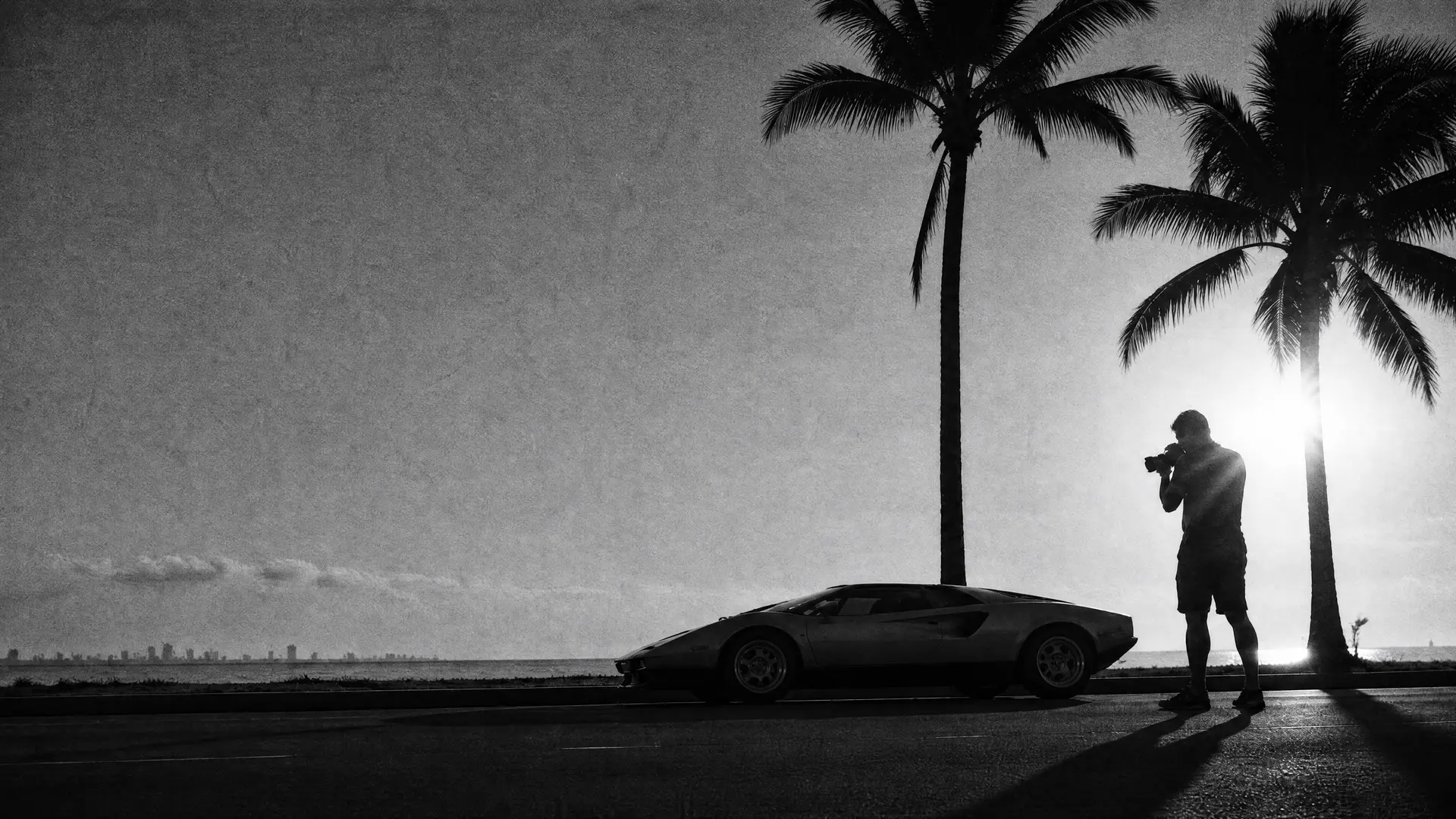
Camilo Rios White doesn’t shoot in a studio if he can help it. A studio has no weather, and weather is the point. He’d rather be outside, in the 305, where the light does half the work and the colour does the rest: Miami gives him colour, he says, and colour gives him life. So he takes the car and the model out into it, into the heat and the palms and the low falling sun, and he shoots them the same way: like two beautiful machines that happen to be in love.
That is more or less his entire career, and he means it literally. His stated obsession, as he once put it to Maxim, is the parallel between the moving sensuality of car and woman: the interplay of fashion, design, engineering and the body, all in one frame. His patron saints are Guy Bourdin and Chris von Wangenheim, the surreal-erotic fashion photographers of the 1970s, whose work he has spent his adult life dragging into the present. The result looks like a Vogue shoot that wandered onto the set of a 1986 Countach commercial and decided to stay. He calls himself, with the flat confidence of a man who has stopped explaining, a fashion photographer who loves cars.
He came to it the long way. Medellín first, then Fort Worth, and then Miami, which is where people like Camilo become themselves. He was Creative Director at The Webster before he was an artist; he learned the building before he left it. The leaving happened, properly, in 2018, with a book: five hundred pages, a box edition, a signing on The Webster’s own Miami floor. “I’ve spent my life collecting the photo books of the people who inspire me,” he said, “and dreaming of having my own. This is that moment.” You can hear the whole arc in it: the kid who collected other people’s myths, finally printing his.
Like two beautiful machines that happen to be in love.
Everything since has been the same instinct, multiplied. The campaigns: Off-White, TAG Heuer, ERES Paris, L’Oréal, the Miami Design District. The magazines that ran him: Elle, Vogue Mexico and Brazil, L’Officiel, GQ, Time, Grazia. A streetwear line, United Rivers. RIOCAM Studios, the art platform. Toys for Boys, the magazine he helped found and art-directs. Prints sold on Alcantara velvet, because of course they are. A hundred and thirty-two thousand people on Instagram watching him stage one-offs, a Bertone Runabout here, a Countach there, like a man arranging the most expensive still lifes on earth. Last year he folded all of it into a single room at ModaMiami: RIOCAM × Miami Vice, the brand eating its own source code.
What makes RIOCAM a brand and not just a portfolio is that the obsession became a language. The airbrushed sunset. The faux 1984. The chrome wordmark, the race-team jersey, the legs in the open roof. Nostalgia for a Miami that was always half-invented, executed with total sincerity and a wink: the only way nostalgia is ever allowed to work.
Which is, more or less, why we’re doing this together.
Hiconium prices the unpriceable: the cars sold in the dark, for numbers nobody says out loud. RIOCAM does the harder thing: he makes you feel why the number was ever that high. We know what your car is worth. Camilo knows what it looks like at golden hour with the roof down. One of us writes the figure; the other writes the desire it was always standing in for.
This August we launch together at The Quail, on a lawn in Carmel Valley, in a colourway we’re calling Caramel, the first of them, themed to the machines on the grass. It is a strange and perfect place for a Miami photographer and a Zürich pricing platform to shake hands: a Californian field full of the exact cars he has spent his life turning into myth, and we have spent ours learning to value.
He’ll be the one shooting them outside, in the light. We’ll be the ones who can tell you, to the franc, what you’re looking at.
You live it. He shoots it. We’ll price it.