Corvette

America's sports car

Three hundred hand-built Polo White roadsters nearly died of indifference in 1954 — then Ed Cole's V8, Zora Arkus-Duntov's engineering and Ford's Thunderbird gave Chevrolet reasons to keep going. Thirty model years later the first three Corvette generations had produced the split-window coupé, the L88 and America's definitive sports car.

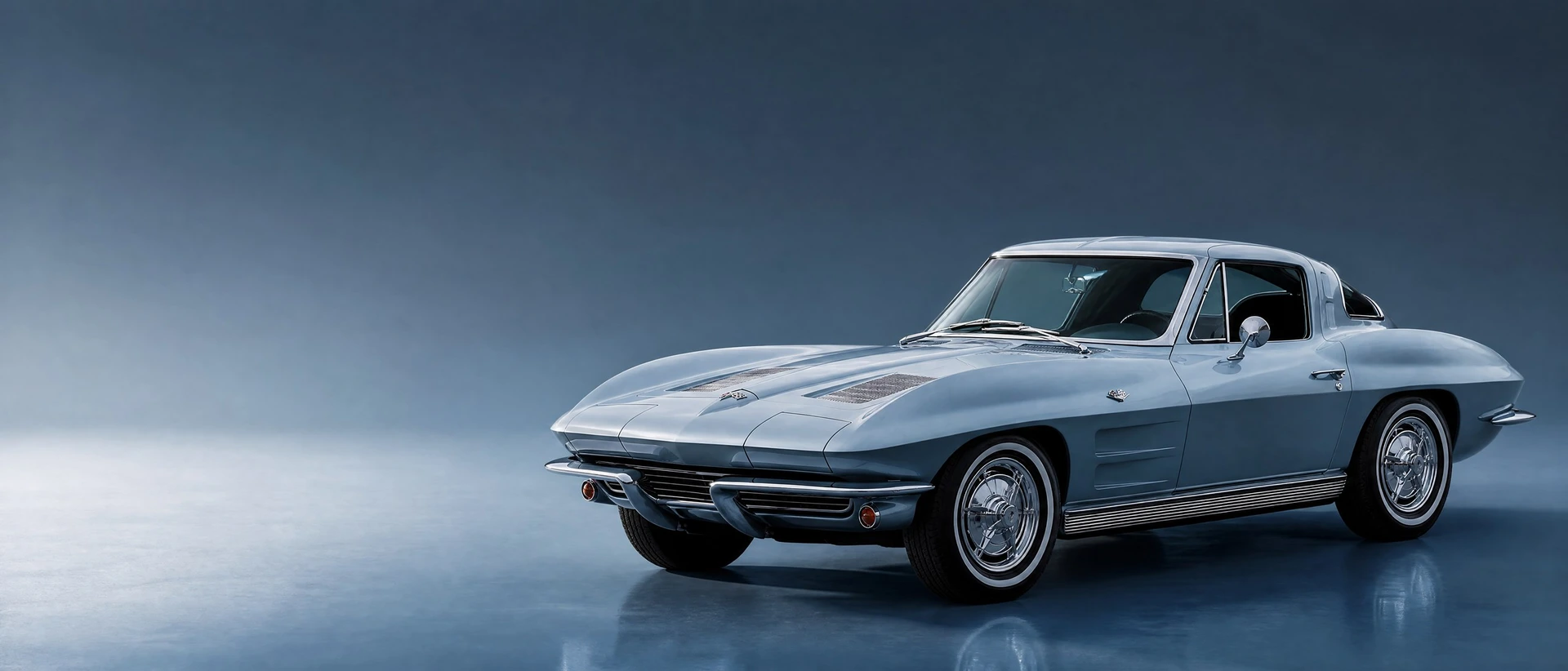
A Silver Blue 1963 Corvette Sting Ray split-window coupé, front three-quarter view on a deep steel-blue field in cool daylight

Market value · road

$45K$250K

Typical $148K · 8 sales

$38K$265K
Open Market & Price

Market value · road

$45K$250K

Typical $148K · 8 sales

$38K$265K
Market history builds with the record
Open Market & Price
Power
150–435 hp (Blue Flame six to L71 427 · SAE gross)
Split window
10'594 (coupés — one year only, 1963)
L88
216 built (1967–69 · rated 430 hp on purpose)
Rear axle
IRS, 1963 (Duntov's transverse-leaf independent)
Peak year
53'807 (model year 1979)
Record
$3.85M (1967 L88 coupé · Scottsdale 2014)

Market & Price

The price and the proof

A terminal for one car: the model curve over the documented record, the benchmarks it is measured against, and the instruments that read it.

Records: 8 documented road sales on file · 2024–2026; estimate band $45K–$250K · good road cars. recorded sale prices · mixed hammer and premium-inclusive basis.

HCN:CORVETTELive model
$106'06674.2% · 12M
$50K$100K$200KDec 23Nov 24Oct 25Sep 26Aug 27S&P 500
Model curve · anchored to 7 documented salesnot investment advice
The readouts · model figures against the benchmarks7 documented anchors · last sale 2 mo ago

Compound annual growth

WindowThis car*S&P 500Gold
1Y+74.2%+18.8%+21.9%

*Modeled price CAGR · S&P is a price index, no dividends

Deepest drawdown · model window

This car*-74.7%Jan 2024Mar 2024 · not recovered
S&P 500-11.1%Feb 2025Apr 2025 · recovered Jul 2025
Gold-18.9%Feb 2026Jul 2026 · not recovered

Forecast ladder · model quantiles

HorizonP10P50P90
+6M$87K$105K$128K
+12M$80K$104K$136K
+24M$71K$103K$150K

Median path with the 10th and 90th percentile · not investment advice

Transaction ledger · documented sales

10 of 10 recorded sales · shown in USD · recorded currency in each record

The anchors matter more than the envelope: a 1954 six is a $45'000–$110'000 car, a 1962 327 runs to $150'000 with injection, a 1964 coupé sits between $50'000 and $110'000, and a 1968 427 convertible spans $55'000 to $190'000 depending on paperwork.

Price range · road · openConfidence · mediumThirty model years is not one market. The band covers honest road cars across the three generations: driver-grade C1s and small-block C2/C3s from the mid-$40'000s, documented fuelie C1s and 427 convertibles between $100'000 and $190'000, split-window coupés to about $237'000 at guide top. L88, ZL1 and the five 1963 Grand Sports trade far above it and are excluded.

Floor

$45K

Typical

$148K

Ceiling

$250K

Estimate band for good road cars. 8 documented sales since 2019 plotted below.

$37K$45K$148K$250K$270K
Hover the spectrum to read a value, or a dot for the sale behind it.

Band, axis and sale positions shown in recorded USD. Figures in USD for road-going C1–C3 Corvettes in driver-to-excellent condition. Race-spec cars (L88, ZL1, Grand Sport) and the N03 big-tank coupés are separate markets.

Instrument calibration for this file is in progress — the terminal above reads the documented record directly.

Barrett-Jackson figures include buyer's premium, and Mecum posted results typically include the 10 per cent in-person premium — hammer figures are flagged where known. Hagerty guide figures are date-stamped snapshots (June 2025 to August 2026), not appraisals. C2 production prints as 117'964 or 117'966 — two convertibles built 2 August 1965 divide the registries.

Overview

From Motorama expedient to institution

The Corvette began as EX-122, a hand-built show car for the January 1953 GM Motorama at the Waldorf-Astoria — Harley Earl's answer to the MGs and Jaguars American servicemen had brought home. Chevrolet rushed it into production that June: three hundred cars built on a makeshift line in Flint, every one Polo White over Sportsman Red, powered by a triple-carburettor truck six through a two-speed Powerglide. The car looked like a sports car and drove like a boulevard cruiser, and by the end of 1954 nearly a third of production stood unsold.

What saved it was engineering. Ed Cole's 265 small-block arrived for 1955, Zora Arkus-Duntov — who had joined Chevrolet two days after seeing the Motorama car — kept pushing performance, and Rochester's Ramjet injection made the 1957 283 the small-block that advertised one horsepower per cubic inch. The 1963 Sting Ray then rebuilt the car entirely: a 98-inch chassis with Duntov's independent rear suspension, hidden headlamps, and Mitchell's one-year-only split rear window. Big-blocks followed in 1965, and by 1967 the L88 was a thinly disguised racing engine Chevrolet deliberately underrated at 430 hp.

The 1968 C3 wrapped Shinoda's Mako Shark II language around the Sting Ray chassis and simply refused to die: chrome bumpers until 1972, the last convertible in 1975, a production peak of 53'807 cars in 1979, and a move to Bowling Green in 1981. When the line stopped in October 1982 there was no 1983 model at all — the C4 arrived as a 1984 — and the first thirty years had built about 730'000 cars and an institution.

Generations
C1 1953–62 · C2 1963–67 · C3 1968–82
Built
69'015 · 117'964 · 542'861
Concept
Harley Earl, Project Opel
Engineering
Zora Arkus-Duntov
First year
300 cars, all Polo White

Reference

Technical specifications

The solid-axle cars, 1953–1962

First engine
235.5-cid Blue Flame six, 150 hptriple side-draft Carters, Powerglide only, 6-volt electrics; the 155 hp camshaft belongs to 1955, not 1954
The V8 step
265 small-block, 1955Ed Cole's engine reached the Corvette on 28 October 1954; only 700 cars that year, 693 of them V8s
Ramjet injection
283 hp from 283 cid, 1957Rochester mechanical injection — Chevrolet's 'one hp per cubic inch' advert; Chrysler's 354 Hemi got there in 1956
1962 finale
327 cid, up to 360 hp FI1'918 fuel-injected cars of 14'531; the last C1 with a trunk, on the 102-inch chassis it wore from 1953

Sting Ray and the shark, 1963–1982

C2 chassis
98-in wheelbase, independent rearDuntov's frame-mounted differential with transverse leaf, out of CERV I; four-wheel discs standard from 1965
Big-blocks
396 → 427L78 396/425 arrives 1965 (2'157 cars); the 1968 tree runs L36 390, L68 400, L71 435 with triple Holleys, L89 alloy heads
L88
430 hp on paper12.5:1 race engine sold with heater delete and no radio — period dyno claims run 500-plus, and Chevrolet preferred customers not to order it
Performance
0–60 in 5.3–5.7 sCar and Driver, 427 cars — 'extraordinarily fast and marginally civilized'; quarter mile 13.8 s at 105 mph

The records

0

1953 cars

all Polo White · about 200 survive

0

Split windows

1963 coupés, one year only

0

L88s

20 + 80 + 116, 1967–69

0

Peak year

1979 — the all-time high

HICON BID

Buying interest, silently.

A HICON Bid is a confidential expression of buying interest on the Chevrolet Corvette file — never public, never shown to other members. It is not a binding purchase, and HICONIUM holds no funds.

Sign in

HICON Bids are a member instrument. Sign in to place one.

The vault

Open a file on yours.

You keep one? The record starts in your garage — identity, papers, photography, and the market evidence this file already carries, bound to your chassis.

The variants

One badge, 3 executions

The register separates the Corvette into its documented executions. One reference silhouette per execution — each opens as its own file as the archive fills.

Chevrolet Corvette C1 Solid Axle — reference silhouetteC1 Solid Axle01
Reference in preparationC2 Sting Ray02
Reference in preparationC303

3 executions on file · references drawn to the house standard

The hands

The people behind the car

The people whose work shaped the Chevrolet Corvette.
No free period portrait on record

Harley Earl

Concept originator

GM's styling vice-president saw the postwar sports-car gap and sold the two-seater to management in 1951 as the secret Project Opel; the Motorama EX-122 was his car.

No free period portrait on record

Ed Cole

Chevrolet chief engineer

Father of the 265 small-block and the man who put it in the Corvette for 1955 — then kept funding the program as general manager. 'Kick the hell out of the status quo.'

No free period portrait on record

Zora Arkus-Duntov

Chief engineer in all but title

Joined 1 May 1953 after seeing the Motorama car; delivered the C2's independent rear, CERV I, the L88 program and the racing pedigree. The museum calls him the Godfather of the Corvette.

No free period portrait on record

Bill Mitchell

Design chief

Earl's successor made the Corvette his own: the 1959 Stingray Racer campaigned privately around GM's racing ban, the split window he refused to surrender until 1964, and the Mako Sharks.

No free period portrait on record

Larry Shinoda

Designer

Drew the production C2 surfaces under Mitchell and shaped Mako Shark II into the C3 — the two most recognisable Corvette bodies of the century.