D-Type

Built to win Le Mans

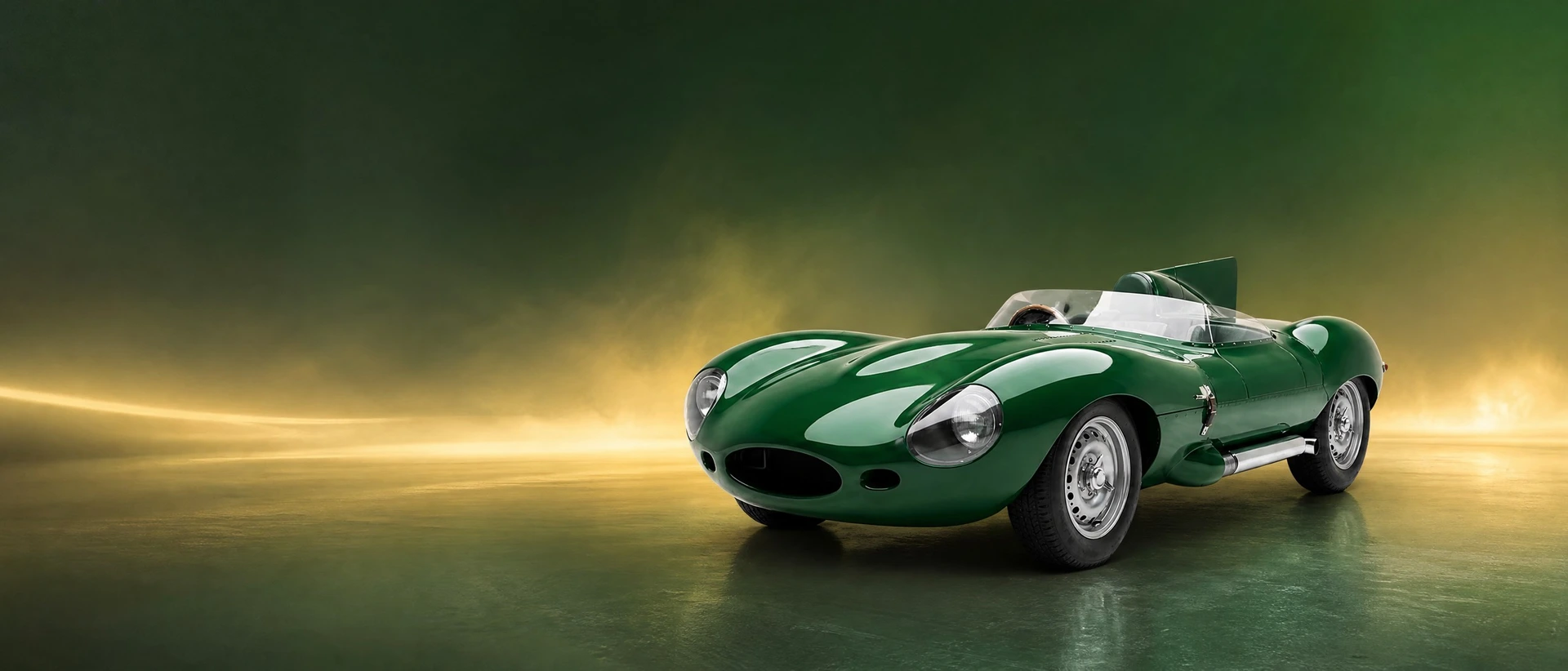
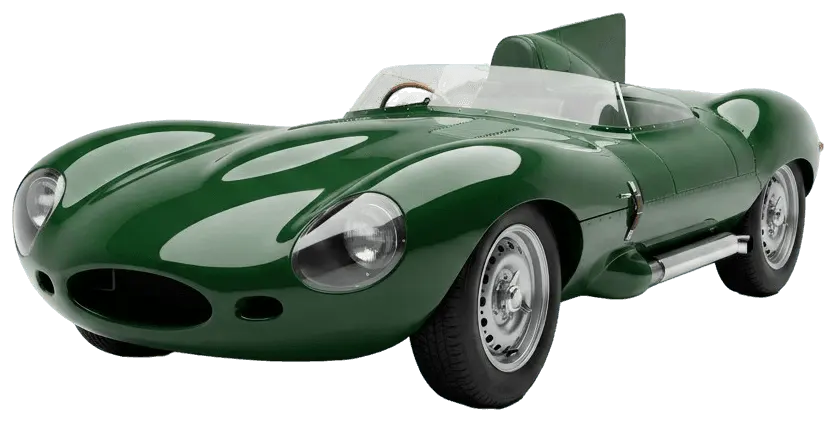
The D-Type put an aircraft-derived monocoque, dry-sump XK six and disc brakes around one target: Le Mans. It won in 1955, 1956 and 1957. Period race history and original structure decide which cars lead the market.

Market value · road

USD 6,000,000–USD 9,000,000

Typical USD 7,500,000 · 4 sales
USD 260,960.64USD 9,540,000
Open Market & Price

Market value · road

USD 6,000,000–USD 9,000,000

Typical USD 7,500,000 · 4 sales
USD 260,960.64USD 9,540,000
’04’21
Market history · in the terminal
Open Market & Price
Top speed
Over 170 mph (~274 km/h · Heritage Trust)
Power
245–270 bhp (3.4L XK six · specification-dependent)
Engine
3'442 cc (DOHC inline six · dry sump)
Transmission
4-speed (manual)
Brakes
Four-wheel discs (Dunlop)
Wheelbase
90 in (2'286 mm)

Market & Price

Jaguar D-Type price & market value

The Jaguar D-Type reference estimate is USD 6,000,000–USD 9,000,000. The file contains 16 documented road sales and 1 documented competition sale, with individual specifications recorded separately. Actual prices depend on specification, condition and provenance; this range is not an offer or a confirmed sale price.

Records: 16 documented road sales on file · 2004–2021; estimate band USD 6,000,000–USD 9,000,000 · good road cars. recorded sale prices · mixed hammer and premium-inclusive basis.
HCN:DTYPELive model
$7'348'469116.7% · 12M
USD 500,000USD 1,000,000USD 2,000,000USD 5,000,000USD 10,000,000USD 20,000,000USD 50,000,00020182020202220242026CovidRate shockFORECASTS&P 500
Model curve · anchored to 16 documented salesnot investment advice

Model forecast · 16 Jul 2027

12 months from the model baseline

Lower · P10
USD 6,095,193.85
-17.1% vs baseline
Median · P50
USD 7,960,501.68
+8.3% vs baseline
Upper · P90
USD 10,396,648.34
+41.5% vs baseline

Model data: Jul 2026 · 16 documented sale anchors. Modeled history between documented sales.

How to read this forecast

P50 is the model median. The outer shading spans P10–P90; the darker band spans P25–P75. These are model quantiles, not verified probabilities or observed sale prices. The calculation extends the modeled trend and volatility; it does not include new listings, vehicle condition or transaction costs.

The readouts · model figures against the benchmarks16 documented anchors · last sale 56 mo ago

Compound annual growth

WindowThis car*S&P 500Gold
1Y+116.7%+18.8%+21.9%
5Y+37.9%+11.4%+17.6%
10Y-9.3%+13.3%+11.8%

*Modeled price CAGR · S&P is a price index, no dividends

Deepest drawdown · model window

This car*-98.8%Jul 2008 → Sep 2009 · recovered May 2011
S&P 500-50.8%Oct 2007 → Mar 2009 · recovered Mar 2013
Gold-39.3%Sep 2011 → Dec 2015 · recovered Jul 2020

Forecast ladder · model quantiles

HorizonP10P50P90
+6MUSD 6,304,686.3USD 7,648,365.95USD 9,278,415.9
+12MUSD 6,095,193.85USD 7,960,501.68USD 10,396,648.34
+24MUSD 5,920,581.55USD 8,623,508.52USD 12,560,404.52

Median path with the 10th and 90th percentile · not investment advice

Transaction ledger · documented sales

17 of 17 recorded sales · shown in USD · recorded currency in each record

Public results rose from $2'090'000 for XKD 558 in 2010 to $6'000'000 for XKD 518 in 2021. XKD 501's $21'780'000 result is a provenance record, not a normal-car benchmark.

Price range · road · openConfidence · lowThree public sales document the model, but the sample is thin and spans very different cars. The core band centres on the $6'000'000 XKD 518 result; Le Mans participation, originality and continuous chassis history can move an individual car far beyond it.

Floor

USD 6,000,000

Typical

USD 7,500,000

Ceiling

USD 9,000,000

Estimate band for good road cars. 4 documented sales since 2019 plotted below.

USD 255,523.96USD 6,000,000USD 7,500,000USD 9,000,000USD 9,720,000
Hover the spectrum to read a value, or a dot for the sale behind it.

Band and axis shown in USD. Sale positions use indicative fixed-rate conversion to USD; sale readouts retain recorded currencies. Figures in USD for original-period D-Types. Jaguar Classic continuation cars are excluded.

The wider market · Jaguar at auction · median per year · modeled between anchors1,681 lots · 2003–2026 · exact yearly anchors · modeled line

Instrument calibration for this file is in progress — the terminal above reads the documented record directly.

Published auction totals include buyer's premium. Chassis identity, original components and period competition history require car-by-car review.

Overview

A monocoque for one circuit

The prototype was completed in May 1954. Tony Rolt took it to the Le Mans test and cut the lap record by five seconds; three further cars were prepared for the race, where Duncan Hamilton and Rolt finished second.

Mike Hawthorn and Ivor Bueb gave the works team its first D-Type Le Mans win in 1955. Ron Flockhart and Ninian Sanderson won for Ecurie Ecosse in 1956. Jaguar announced its withdrawal from international motor sport that October.

Privateers returned in 1957 and filled first through fourth plus sixth at Le Mans, with Ecurie Ecosse first and second. The February factory fire had destroyed five D-Types and disrupted the parallel XKSS programme; surviving chassis histories remain unusually individual.

Built
75 originals
Le Mans wins
3
Structure
Monocoque
Body designer
Malcolm Sayer
Forms
Shortnose · Longnose

Reference

Technical specifications

Powertrain

Engine
XK DOHC inline six3'442 cc in the customer-car specification
Induction
Three Weber 45 DCO3 carburettorslater works longnose cars used fuel injection
Power
245–270 bhpRM quotes 245–250 bhp for customer cars; Jaguar Heritage gives 270 bhp for its works prototype
Lubrication
Dry sumplet the engine sit lower in the body
Gearbox
4-speed manual

Chassis

Structure
Central alloy monocoquetub carries the cockpit and rear loads
Front structure
Tubular subframecarries engine, steering and front suspension
Front suspension
Independenttorsion bars and telescopic dampers
Rear suspension
Live axletrailing links, transverse torsion bar and Panhard rod
Brakes
Dunlop discsall four wheels
Drive position
Right-hand driveall original D-Types

The records

0

Le Mans wins

1955, 1956 and 1957

>0mph

Top speed

Jaguar Heritage figure

0

Top-six finishers

Le Mans 1957

0

Original cars

Jaguar Classic count

HICON BID

Buying interest, silently.

A HICON Bid is a confidential expression of buying interest on the Jaguar D-Type file — never public, never shown to other members. It is not a binding purchase, and HICONIUM holds no funds.

Sign in

HICON Bids are a member instrument. Sign in to place one.

The vault

Open a file on yours.

You keep one? The record starts in your garage — identity, papers, photography, and the market evidence this file already carries, bound to your chassis.

The variants

One badge, 3 executions

The register separates the D-Type into its documented executions. One reference silhouette per execution — each opens as its own file as the archive fills.

Jaguar D-Type Short Nose — reference silhouetteShort Nose01
Reference in preparationLong Nose02
Reference in preparationWorks03

3 executions on file · references drawn to the house standard

The cars

The D-Type register

Documented individual cars — chassis, colour, ownership and sale history. Open one for its full provenance. Public records only; members see the complete registry.

03 documented · public records

The hands

The people behind the car

The people whose work shaped the Jaguar D-Type.

Malcolm Sayer

Aerodynamicist and body designer

Applied aircraft-derived calculation and wind-tunnel work to the low frontal area, clamshell body and stabilising tail fin.

William Heynes

Chief engineer

Directed the programme and the central-monocoque architecture that replaced the C-Type's full spaceframe.

No free period portrait on record

Walter Hassan

Engine development engineer

Worked with Heynes on dry-sump lubrication and the canted XK installation that lowered the bonnet line.

No free period portrait on record

F. R. W. “Lofty” England

Competitions manager

Set the racing brief and ran Jaguar's works competition programme through the D-Type years.