E-Type

150 mph for £2'097

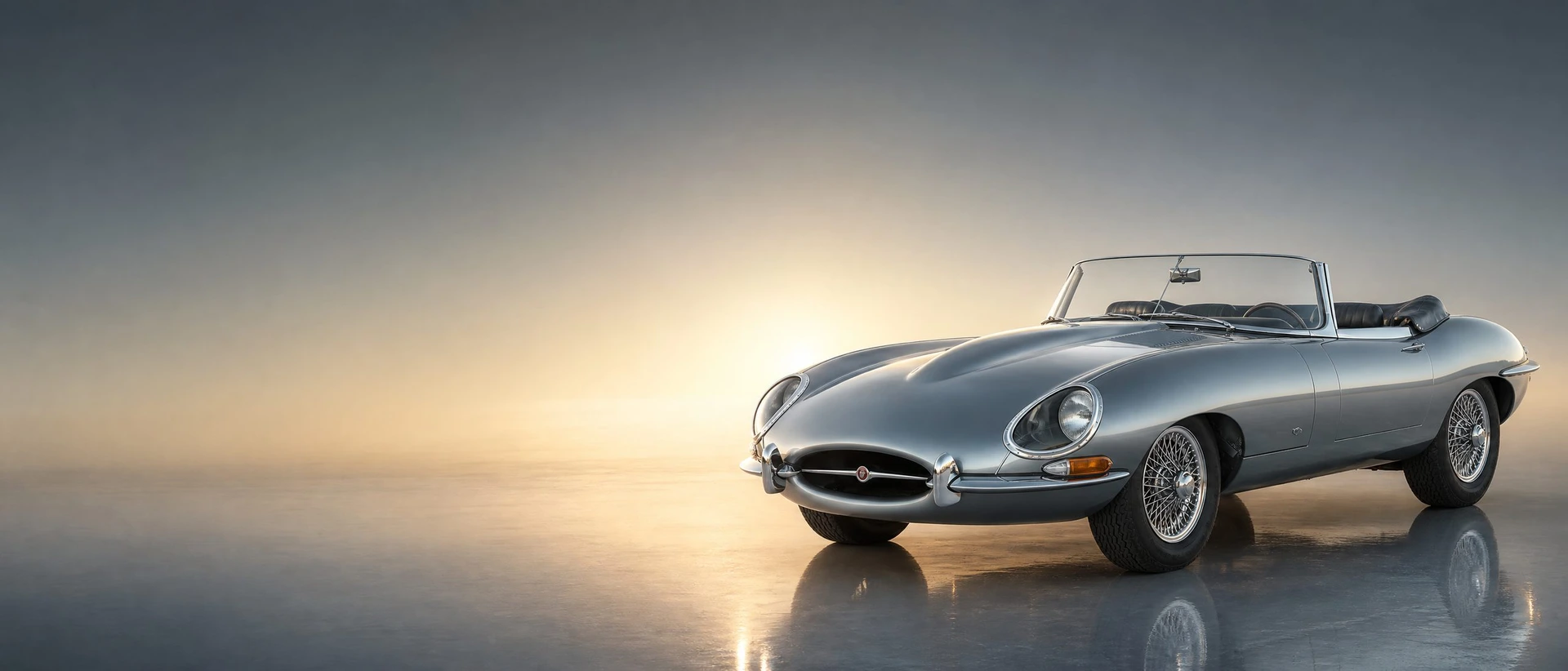
Malcolm Sayer shaped the E-Type from calculated ellipses, on a monocoque-and-subframe recipe taken straight from the D-Type — then Jaguar sold it for a third of a Ferrari's price. Series, body style and the earliest details decide which cars lead the market.

Market value · road

$60K$300K

Typical $180K · 0 sales

$51K$318K
Open Market & Price

Market value · road

$60K$300K

Typical $180K · 0 sales

$51K$318K
Market history builds with the record
Open Market & Price
Top speed
149.1 mph (The Motor, 1961 · prepared press car)
Power
265 bhp (SAE gross · 3.8 XK six)
Engine
3'781 cc (DOHC inline six · triple SU)
Transmission
4-speed (Moss box · all-synchro from 1964)
Brakes
Four-wheel discs (Dunlop · inboard at the rear)
Wheelbase
96 in (2'438 mm · 2+2 and V12: 105 in)

Market & Price

The price and the proof

A terminal for one car: the model curve over the documented record, the benchmarks it is measured against, and the instruments that read it.

Records: 1 documented road sales on file · 2017–2017; estimate band $60K–$300K · good road cars. recorded sale prices · mixed hammer and premium-inclusive basis.

HCN:ETYPELive model
$134'164-33.7% · 12M
$100K$200K$500K$1M$2M$5M$10M$20M20192021202320242026CovidRate shockS&P 500
Model curve · anchored to 1 documented salesnot investment advice
The readouts · model figures against the benchmarksSynthetic model · insufficient ledger

Compound annual growth

WindowThis car*S&P 500Gold
1Y-33.7%+18.8%+21.9%
5Y-36.3%+11.4%+17.6%

*Modeled price CAGR · S&P is a price index, no dividends

Deepest drawdown · model window

This car*-98.3%Aug 2017Jul 2026 · not recovered
S&P 500-20.3%Dec 2021Oct 2022 · recovered Dec 2023
Gold-18.9%Feb 2026Jul 2026 · not recovered

Forecast ladder · model quantiles

HorizonP10P50P90
+6M$122K$133K$145K
+12M$118K$132K$147K
+24M$112K$130K$151K

Median path with the 10th and 90th percentile · not investment advice

Transaction ledger · documented sales

2 of 2 recorded sales · shown in USD · recorded currency in each record

The best road car result is £911'250 for the first customer roadster at Gooding London in 2023. The twelve 1963–64 Lightweights are a separate market: $7'370'000 and $8'000'000 at Bonhams in 2017 remain the public ceiling.

Price range · road · openConfidence · mediumThe E-Type trades in volume, so guide coverage is deep; the band spans honest drivers to concours Series 1 two-seaters. Series, body and originality move a car across the whole band: Series 2, 2+2 and automatic cars sit low, covered-headlight Series 1 roadsters high. Flat-floor early cars and anything with period competition history price above it.

Floor

$60K

Typical

$180K

Ceiling

$300K

Estimate band for good road cars. 0 documented sales since 2019 plotted below.

$49K$60K$180K$300K$324K
Hover the spectrum to read a value, or a dot for the sale behind it.

Band, axis and sale positions shown in recorded USD. Figures in USD for six-cylinder road cars across Series 1–3. Lightweights, Low Drag and continuation cars are excluded.

The wider market · Jaguar at auction · median per year · modeled between anchors1,681 lots · 2003–2026 · exact yearly anchors · modeled line

Instrument calibration for this file is in progress — the terminal above reads the documented record directly.

Published auction totals include buyer's premium. Guide bands are date-stamped snapshots — Hagerty and Classic Trader, 2025 — not appraisals; matching numbers, Heritage Certificate colours and early-car details require car-by-car review.

Overview

The racer's recipe, sold at a road-car price

Jaguar had left works racing in 1956 with the D-Type's construction proven. The E-Type carried it to the road: a monocoque tub, a bolted front subframe, Malcolm Sayer's calculated ellipses, and Bob Knight's new independent rear suspension. At Geneva in March 1961 the roadster cost £2'097 including tax — an Aston Martin cost roughly twice as much, a Ferrari three times.

The launch tests printed 149 to 150 mph from factory-prepared press cars on racing tyres; honest customer cars ran slower, and nobody cared. The 4.2 of October 1964 brought torque, an all-synchromesh gearbox and better seats behind the unchanged shape; the long-wheelbase 2+2 of 1966 added occasional seats and the first automatic. From 1967 American regulation opened the headlights and leaned the US engines — the transitional cars collectors call Series 1½, then the Series 2 of 1968.

The Series 3 of 1971 put Jaguar's new 5.3-litre V12 into the long floor and made the E-Type a grand tourer; the last car was built in June 1974, closing at about 72'500 cars. The shape never left the culture: MoMA took a 1963 roadster as only the third automobile in its collection in 1996, and in 2014 Jaguar completed the six unused Lightweight chassis numbers as continuation cars.

Built
About 72'500
Series
1 · 2 · 3
Bodies
OTS · FHC · 2+2
Body designer
Malcolm Sayer
US name
XK-E

Reference

Technical specifications

Powertrain

Engine, 1961–1964
XK DOHC inline six, 3'781 cctriple SU HD8, 265 bhp SAE gross claimed — period testers considered real output lower
Engine, 1964–1971
XK inline six, 4'235 ccsame claimed power, more torque; US emissions cars ran twin Strombergs from 1967
Engine, 1971–1974
V12, 5'343 ccSOHC per bank, four Zenith-Stromberg carburettors, about 272 bhp
Gearbox
4-speed manualMoss box without first-gear synchromesh until October 1964, then Jaguar's all-synchromesh unit; Borg-Warner automatic from the 2+2 onward

Structure and chassis

Structure
Steel monocoque tubbolted square-tube front subframe carries engine, steering and front suspension — the D-Type recipe
Front suspension
Independenttorsion bars and telescopic dampers
Rear suspension
IndependentBob Knight's subframe-mounted IRS — lower wishbones, twin coil-over dampers
Brakes
Dunlop discsall four wheels, inboard at the rear
Wheelbase
96 in / 2'438 mm2+2 and every Series 3 use the 105 in / 2'667 mm floor
Headlights
Glass-covered to 1967open lights on the transitional 1967–68 cars and every Series 2 and 3

The records

0mph

Launch road test

The Motor on 77 RW · prepared press car

$0m

Auction record

Lightweight S850664 · Bonhams 2017

0

Lightweights built

of 18 sanctioned · 1963–64

0

MoMA accession

third automobile in the collection

HICON BID

Buying interest, silently.

A HICON Bid is a confidential expression of buying interest on the Jaguar E-Type file — never public, never shown to other members. It is not a binding purchase, and HICONIUM holds no funds.

Sign in

HICON Bids are a member instrument. Sign in to place one.

The vault

Open a file on yours.

You keep one? The record starts in your garage — identity, papers, photography, and the market evidence this file already carries, bound to your chassis.

The variants

One badge, 3 executions

The register separates the E-Type into its documented executions. One reference silhouette per execution — each opens as its own file as the archive fills.

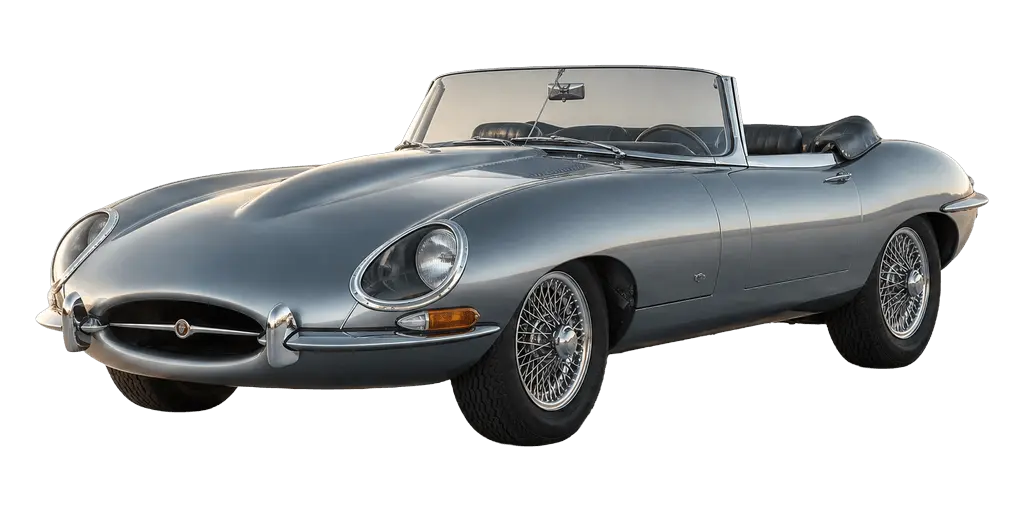
Jaguar E-Type Series 1 — reference silhouetteSeries 101
Reference in preparationSeries 202
Reference in preparationSeries 303

3 executions on file · references drawn to the house standard

The hands

The people behind the car

The people whose work shaped the Jaguar E-Type.
No free period portrait on record

Malcolm Sayer

Aerodynamicist and body designer

Shaped the E-Type from calculated ellipses and wind-tunnel work, carrying his C- and D-Type methods to a production road car.

No free period portrait on record

William Heynes

Chief engineer

Directed the programme: monocoque and subframe architecture, the XK six's road tune, and the engineering release of the 1961 car.

No free period portrait on record

Bob Knight

Ride and handling engineer

Developed the subframe-mounted independent rear suspension that defined the E-Type's ride and carried Jaguar saloons for decades.

No free period portrait on record

Norman Dewis

Chief test engineer

Proved the car in development and drove 77 RW overnight to Geneva when launch demand outran the single show car.

No free period portrait on record

Sir William Lyons

Founder and chairman

Priced the E-Type against cars costing two and three times as much, and kept Sayer's shape unspoiled through the launch decade.