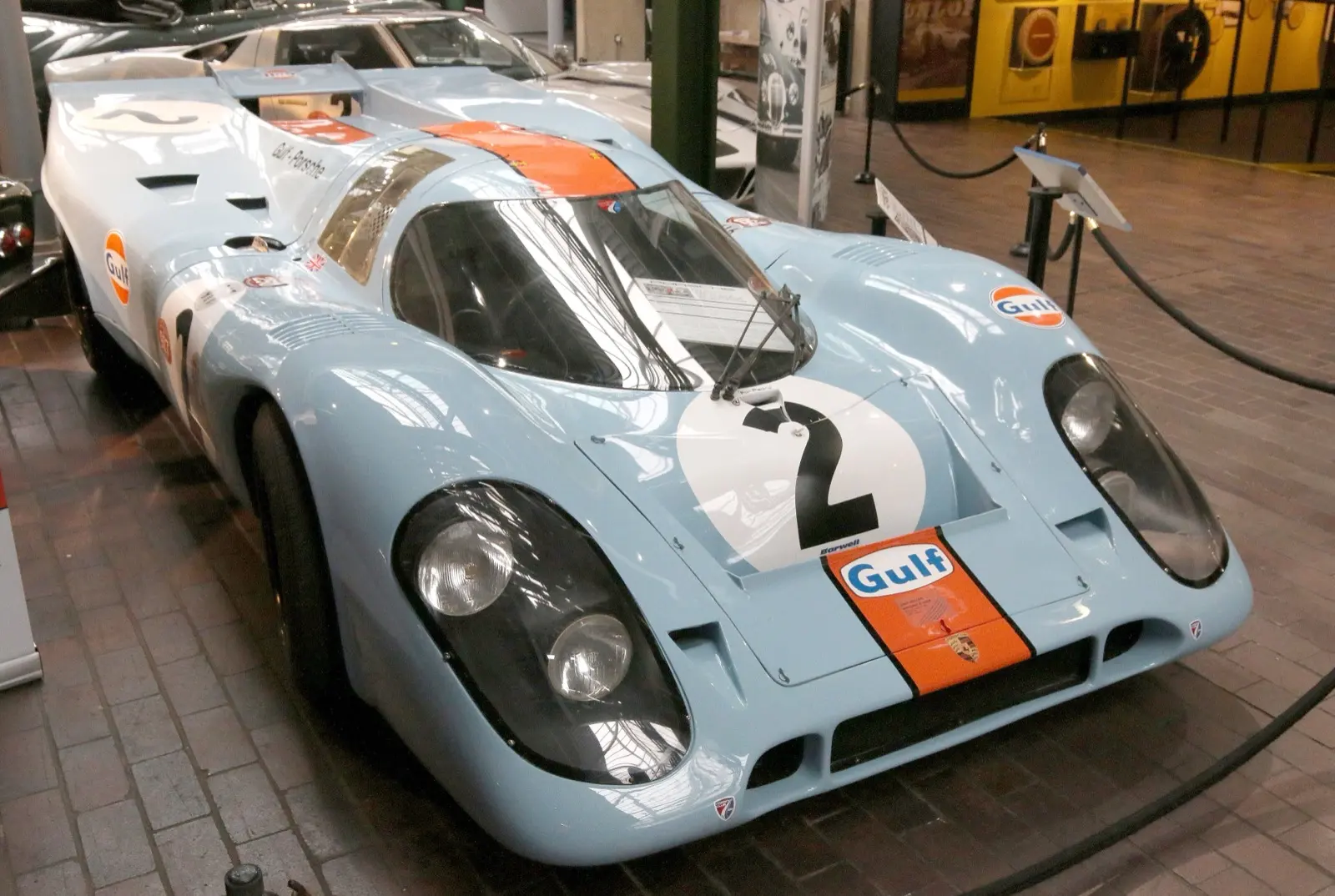
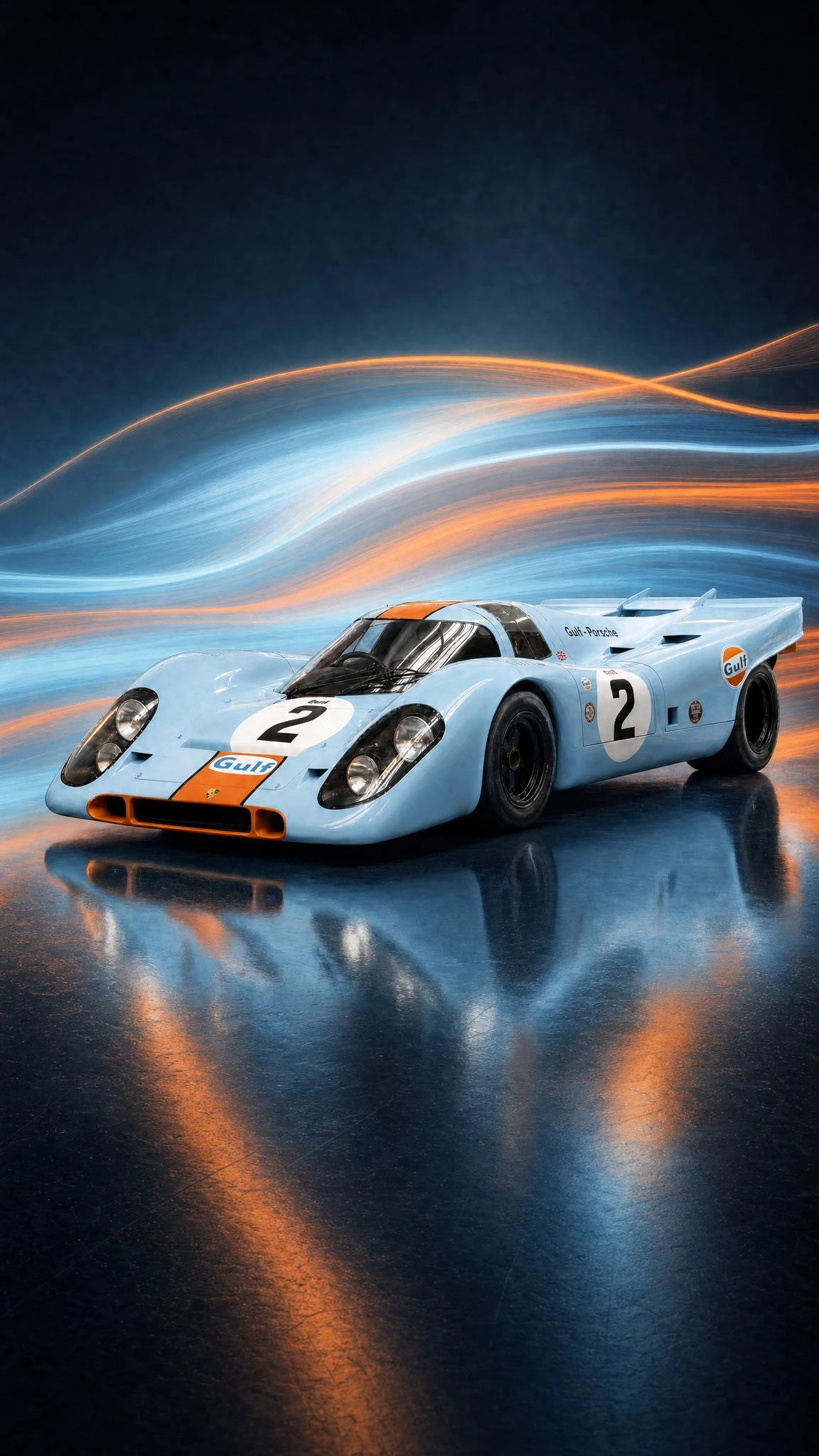

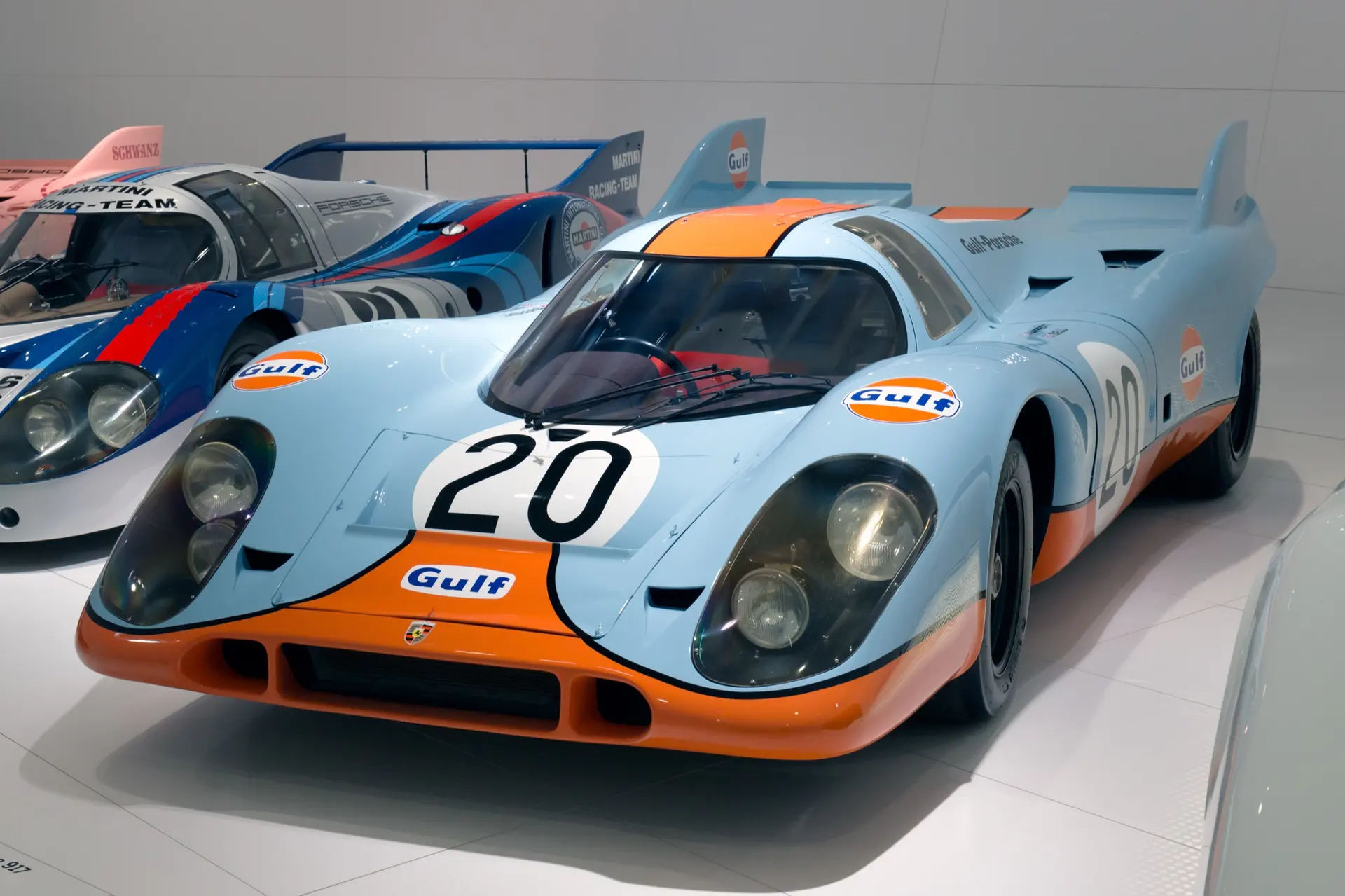
Porsche 917 K in Gulf blue and orange, head-on

917

The most valuable Porsche

Built to a loophole, banned at its peak. Twenty-five cars lined up in a courtyard to satisfy the inspectors; two Le Mans wins later, it is the most valuable Porsche ever sold at auction.

Market value · road

$12M$20M

Typical $14M · 1 sales

$2.8M$21M
Open Market & Price

Market value · road

$12M$20M

Typical $14M · 1 sales

$2.8M$21M
’06’24
Market history · in the terminal
Open Market & Price
Top speed
386 km/h (917 LH · Mulsanne 1971)
Power
630 PS (5.0L flat-12 · Type 912)
Le Mans
2 wins (1970 and 1971)
Weight
800 kg (frame: 42 kg)
Production
59 (1969 to 1973 · all variants)
0 to 100
2.3 s (917/30 Can-Am)
Distance
5'335 km (Le Mans 1971 · stood 39 years)
Can-Am power
1'100 PS (5.4L twin-turbo · 917/30)
List price
DM 140'000 (1969 · ten 911s)
Homologation
25 cars (lined up 20 April 1969)

Market & Price

The price and the proof

A terminal for one car: the model curve over the documented record, the benchmarks it is measured against, and the instruments that read it.

Records: 917 K · 917-024, ex-Siffert “Le Mans” film car — $14,080,000 · Gooding & Co, Pebble Beach · 18 Aug 2017; Bid declined · 917 K · 917-022, the McQueen hero car — $25,000,000 · Mecum Kissimmee · 18 Jan 2025. 5 documented road sales on file · 2006–2024.

HCN:917Live model
$14'080'00097.2% · 12M
$5M$10M$20M20182020202220242026CovidRate shockS&P 500
Model curve · anchored to 5 documented salesnot investment advice
The readouts · model figures against the benchmarks5 documented anchors · last sale 26 mo ago

Compound annual growth

WindowThis car*S&P 500Gold
1Y+97.2%+18.8%+21.9%
5Y+19.2%+11.4%+17.6%
10Y+11.9%+13.3%+11.8%

*Modeled price CAGR · S&P is a price index, no dividends

Deepest drawdown · model window

This car*-79.6%Aug 2017May 2024 · recovered Jul 2026
S&P 500-50.8%Oct 2007Mar 2009 · recovered Mar 2013
Gold-39.3%Sep 2011Dec 2015 · recovered Jul 2020

Forecast ladder · model quantiles

HorizonP10P50P90
+6M$12M$14M$16M
+12M$12M$15M$18M
+24M$12M$15M$20M

Median path with the 10th and 90th percentile · not investment advice

Transaction ledger · documented sales

5 of 5 recorded sales · shown in USD · recorded currency in each record

The 917 taught the market patience: a used racer at $15’000 in 1975, a million-dollar film prop by 2000, a fourteen-million-dollar record by 2017 — and a twenty-five-million-dollar bid, declined, in 2025. Price is a vote cast in an afternoon. Value is what remains, documented below.

Price range · road · openConfidence · lowA market of perhaps a dozen public trades, provenance-driven to a degree no other Porsche approaches. Gulf and film cars set the records; both Le Mans winners sit in museum collections and are effectively priceless; Can-Am turbos trade well below the coupés.

Floor

$12M

Typical

$14M

Ceiling

$20M

Estimate band for good road cars. 1 documented sales since 2019 plotted below.

$2.7M$12M$14M$20M$22M
Hover the spectrum to read a value, or a dot for the sale behind it.

Band and axis shown in USD. Sale positions use indicative fixed-rate conversion to USD; sale readouts retain recorded currencies. The band reflects documented 917 K coupés; the Le Mans winners are museum pieces, and Can-Am turbos trade below it.

Model record

$14,080,000

917 K · 917-024, ex-Siffert “Le Mans” film car

Gooding & Co, Pebble Beach · 18 Aug 2017

Road record

$25,000,000

Bid declined · 917 K · 917-022, the McQueen hero car

Mecum Kissimmee · 18 Jan 2025

The wider market · Porsche at auction · median per year · modeled between anchors1,973 lots · 2003–2026 · exact yearly anchors · modeled line

Instrument calibration for this file is in progress — the terminal above reads the documented record directly.

Documented, FX-normalized public sales with per-field provenance; 917 K coupés only, Can-Am turbos and continuation cars separate. The model curve is synthetic between documented sales. Nothing here is investment advice.

Overview

Piëch’s gamble.

In April 1968 the CSI cut the homologation requirement for five-litre sports cars from fifty cars to twenty-five. Ferdinand Piëch read the rule as an invitation: build a whole grid of prototypes at once and take the outright Le Mans win that had always escaped Porsche. Eleven months later the 917 stood on the Geneva stand at DM 140’000 a copy — a price that did not begin to cover it.

The first cars lifted and wandered at speed until a taped-together aluminium tail, improvised at Zeltweg, became the 917 K. Then it won: Le Mans 1970 in the rain, Le Mans 1971 at a distance record that stood for thirty-nine years — and when the five-litre class was closed on it, Can-Am, twice, with turbochargers, until nobody else would enter.

Ferdinand Porsche signatureFerdinand Porsche
Founder
Power
630 PS
Top speed
386 km/h
Built
59
Le Mans
2 wins
Launch
DM 140'000

Reference

Technical specifications

Powertrain

Engine
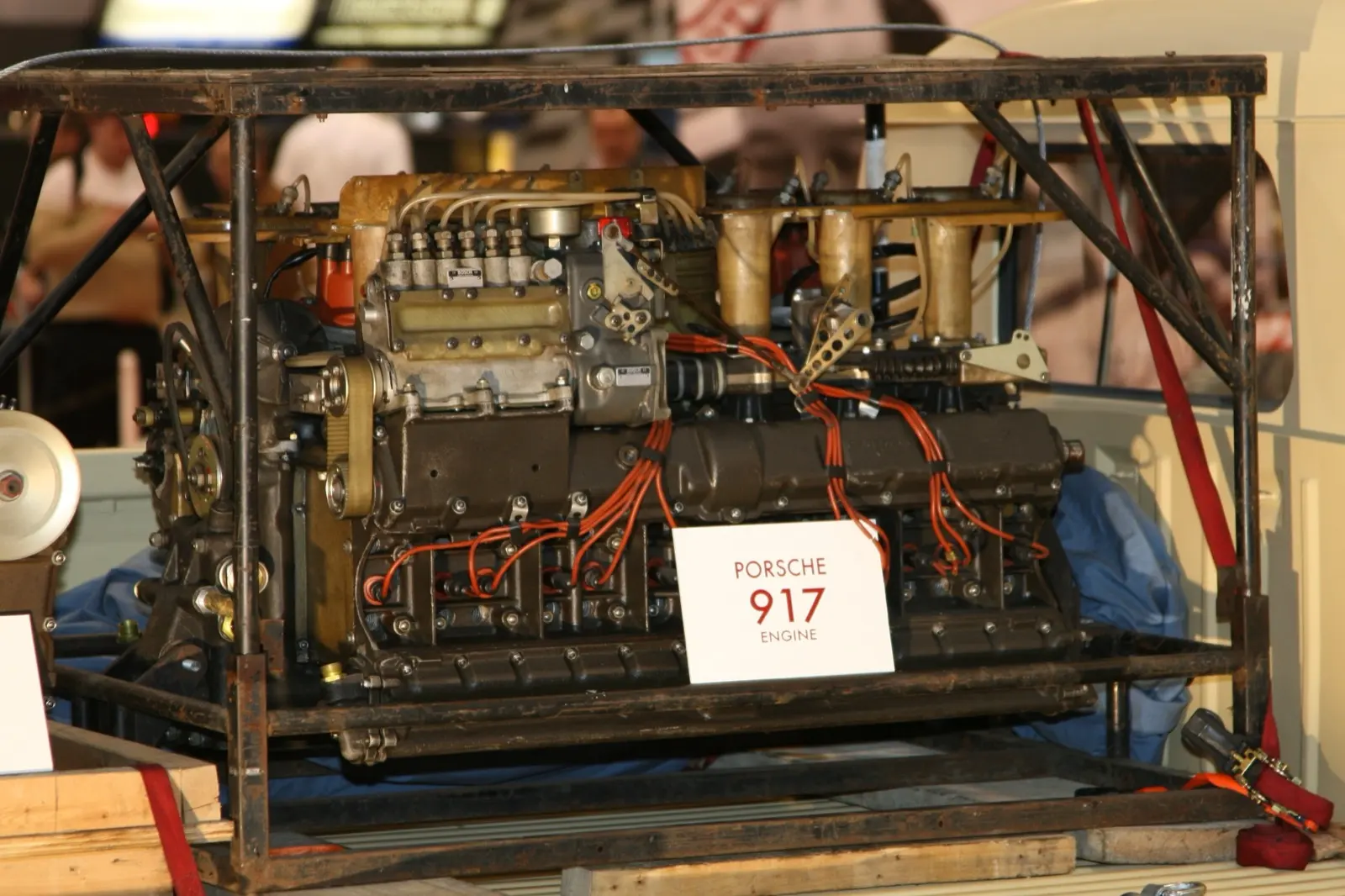
4.5 to 5.0L flat-12, air-cooledType 912 · 180° twelve, twin-plug, Bosch injection, titanium rods
Output
520 to 630 PS4.5L of 1969: ~520 PS; 5.0L of 1971: ~630 PS
Can-Am spec
5'374 cc twin-turbo · 1'100 PSrace trim; to ~1 500 PS on the test bench
Layout
Mid-engine, longitudinal
Cooling
Single engine-driven fanthe horizontal fan is the 917 silhouette

Performance

Top speed
386 km/h (240 mph)917 LH, Mulsanne 1971; Oliver timed unofficially to ~396
0 to 100 km/h
2.3 s917/30 Can-Am
0 to 200 km/h
5.3 s917/30 Can-Am
Le Mans distance
5'335.313 km · 222.304 km/h average1971 — the record stood until 2010
Fastest Le Mans lap
3:13.6 · Jackie Oliver, 1971stood until 2008

Chassis & running gear

Frame
Aluminium spaceframe · 42 kggas-pressurised to reveal cracks; 1971 winner ran magnesium
Suspension
Fully independentBilstein dampers
Brakes
Ventilated discs, unassisted
Driving position
Right-hand seatplaced for clockwise-circuit balance
Wheels
Centre-lock magnesium

Body & cockpit

Construction
Glass-fibre panels over the frame
Dry weight
~800 kgthe magnesium car needed a 55-litre oil tank to reach the minimum
Cockpit
Closed coupé, right-handinterior temperatures past 70 °C
Details
Balsa shift knob, drilled ignition key
Tanks
200+ litres in Can-Am specno scheduled fuel stops

Production & identity

Built
59 chassis (1969 to 1973)43 naturally aspirated — 36 K, 5 LH, 2 Spyder — and 16 turbos; some counts reach 65
Homologation
25 cars, 20 April 1969lined up outside Zuffenhausen; the CSI declined to drive them
Chassis numbers
917-001 onwardrenumbered after crashes and customs — identities famously murky (026↔031)
Reveal
Geneva Salon, March 1969
Launch price
DM 140'000 (~$35'000)roughly ten 911s — and under development cost
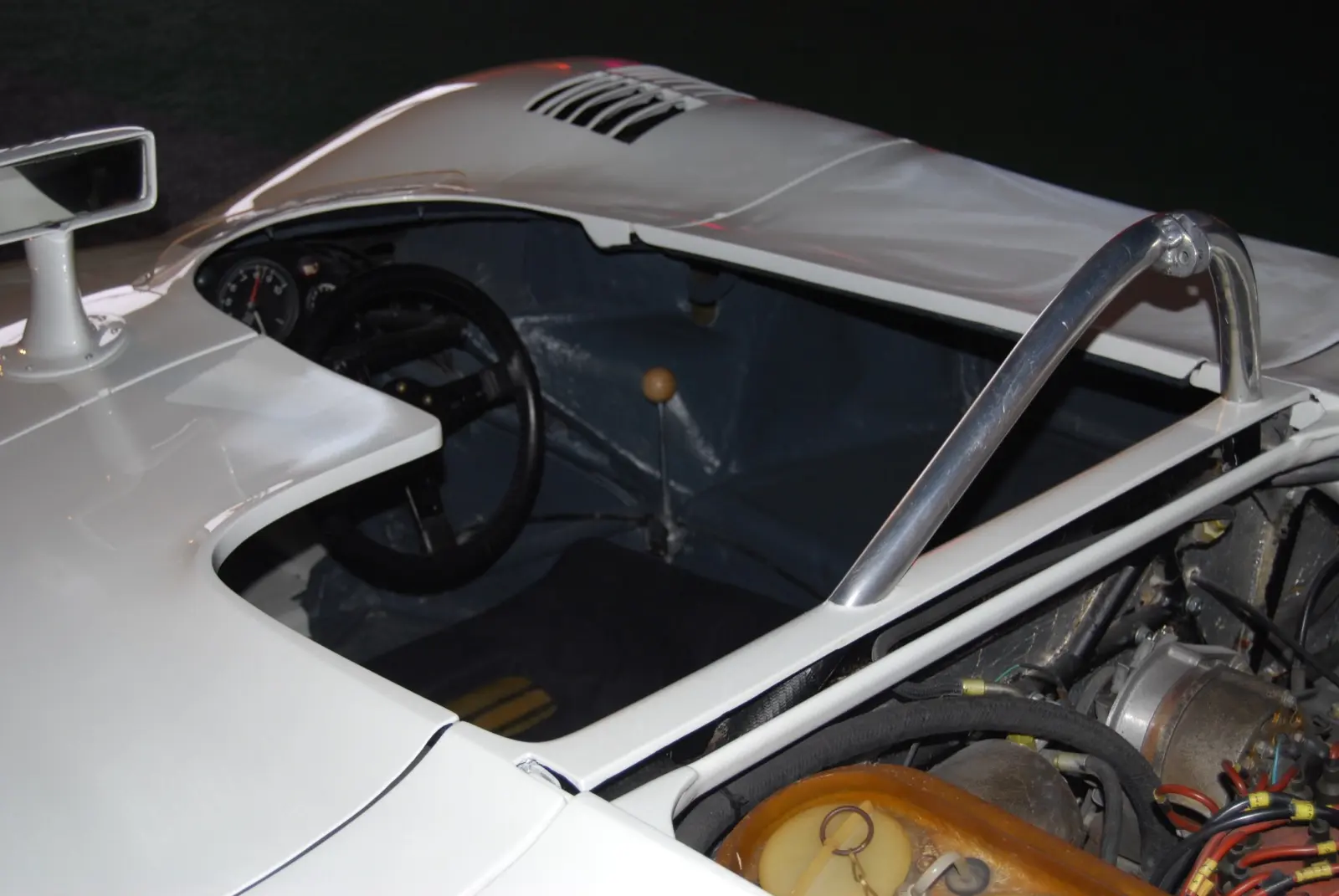
The spartan right-hand cockpit of a 917 prototype
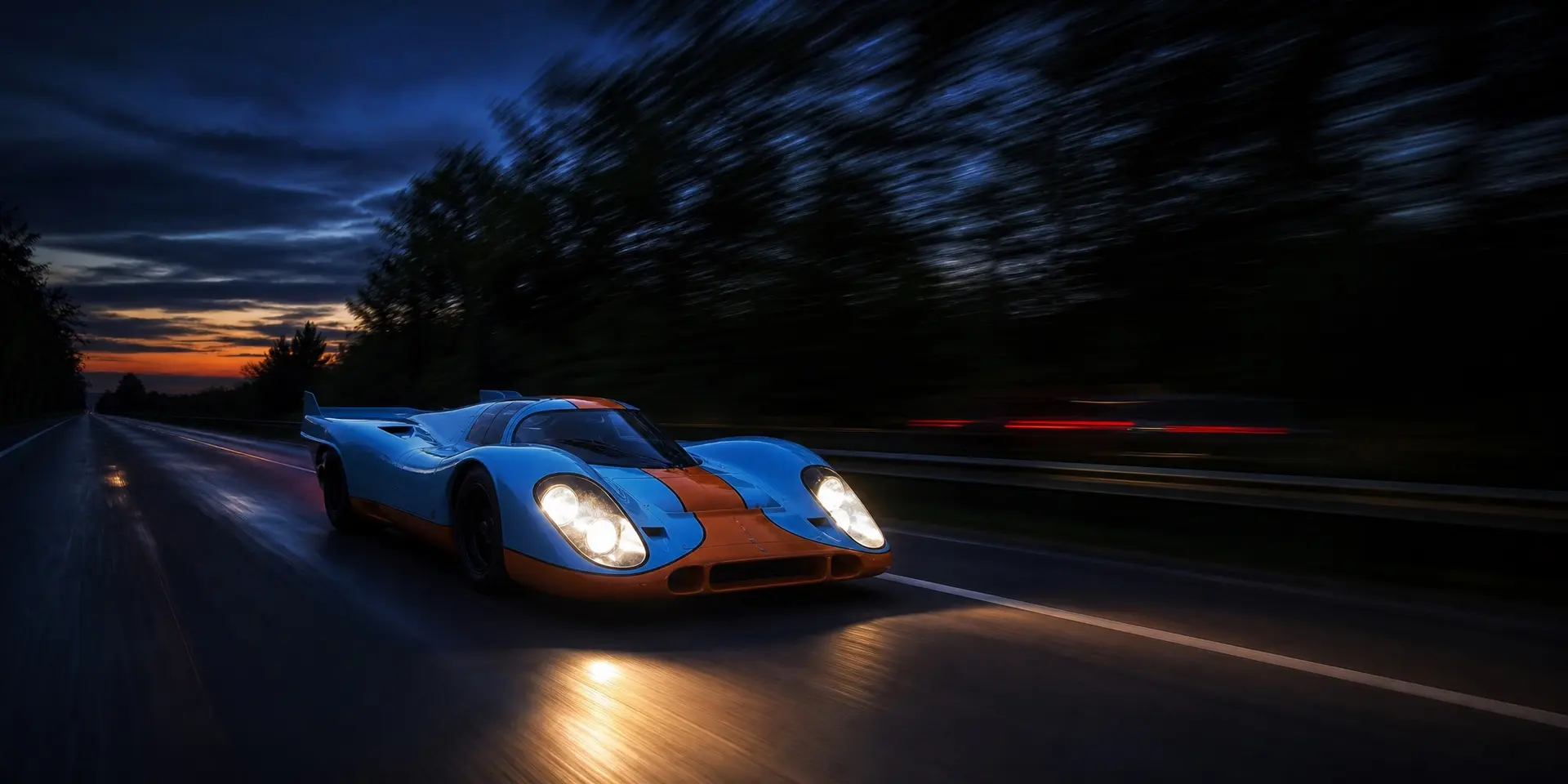
A Gulf Porsche 917 at speed on a dark tree-lined straight at dusk — render
The Type 912 flat-12 on its stand

The records

0km

One race, 1971

Le Mans distance record — stood 39 years

0km/h

Mulsanne straight, 1971

the fastest thing Le Mans had seen

0PS

917/30, race trim

to ~1’500 PS on the works bench

$0million

Kissimmee, 2025

the bid that was declined

The rival

917 vs 512

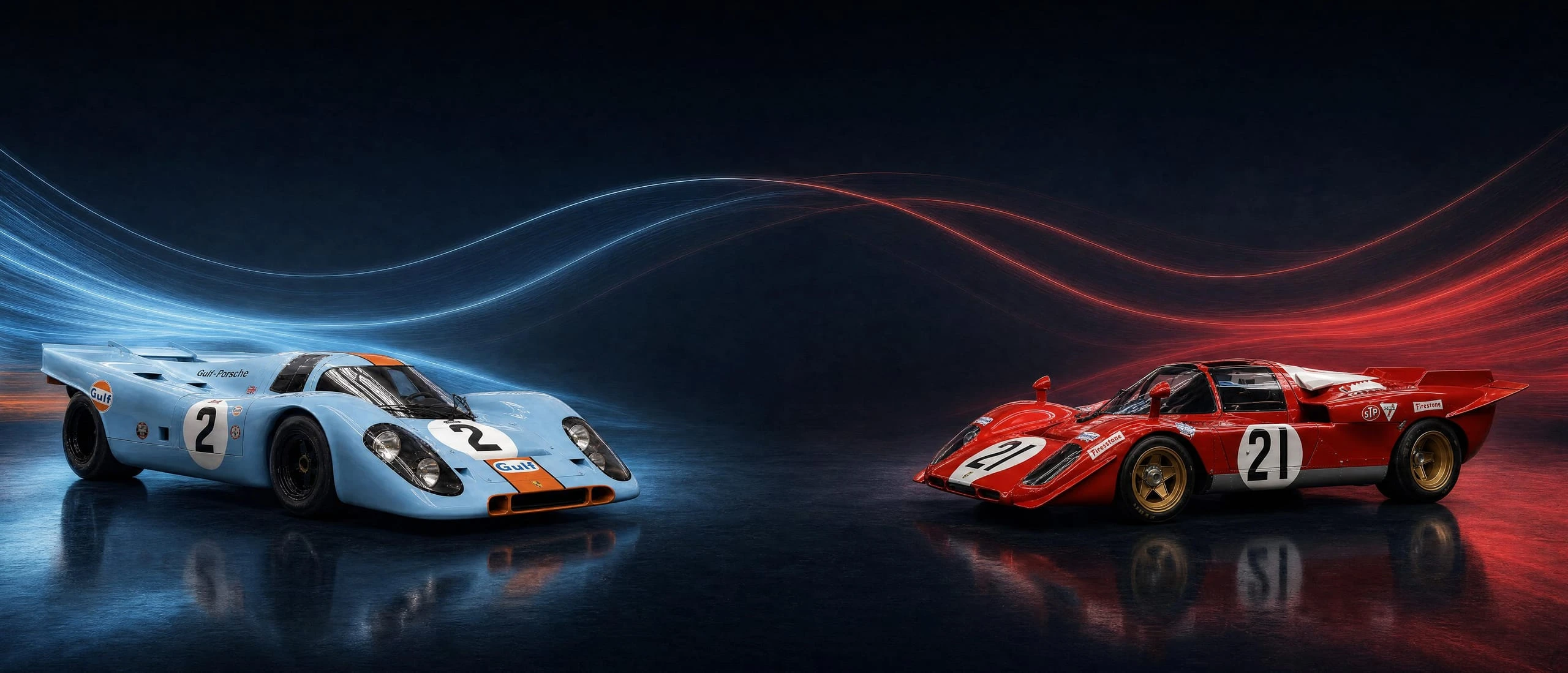
Ferrari answered the same rule with the same trick: twenty-five cars, five litres, twelve cylinders. For one season the two met everywhere that mattered.

The Gulf Porsche 917 K and the Ferrari 512 S nose to nose across a dark studio field, light trails in gulf blue and ferrari red interweaving above

Porsche 917 K

4.5–5.0L flat-12 · air-cooled

Ferrari 512 S

5.0L V12 · water-cooled

25 cars, April 1969Homologation25 cars, early 1970
~580 PSPower, 1970~550 PS
≈800 kgWeight≈840 kg
Champion — 8 of 10 rounds1970 seasonOne championship win

Daytona, February 1970

First meeting at full strength: the Gulf 917s finish one-two; the fastest 512 is third, six laps down.

Sebring, March 1970

Ferrari’s day — Giunti, Vaccarella and Andretti win on reliability as the 917s falter.

Le Mans, June 1970

The decision. Rain, attrition, and a Porsche one-two-three; the best 512 comes home fourth.

Ferrari sold the 512 programme’s remains to privateers for 1971 and left the class; Porsche stayed and kept winning.

The silhouettes

One car, three bodies

Fifty-nine chassis, one architecture — and completely different answers to what the air should do with it. Every 917 in the register below wears one of these three silhouettes.

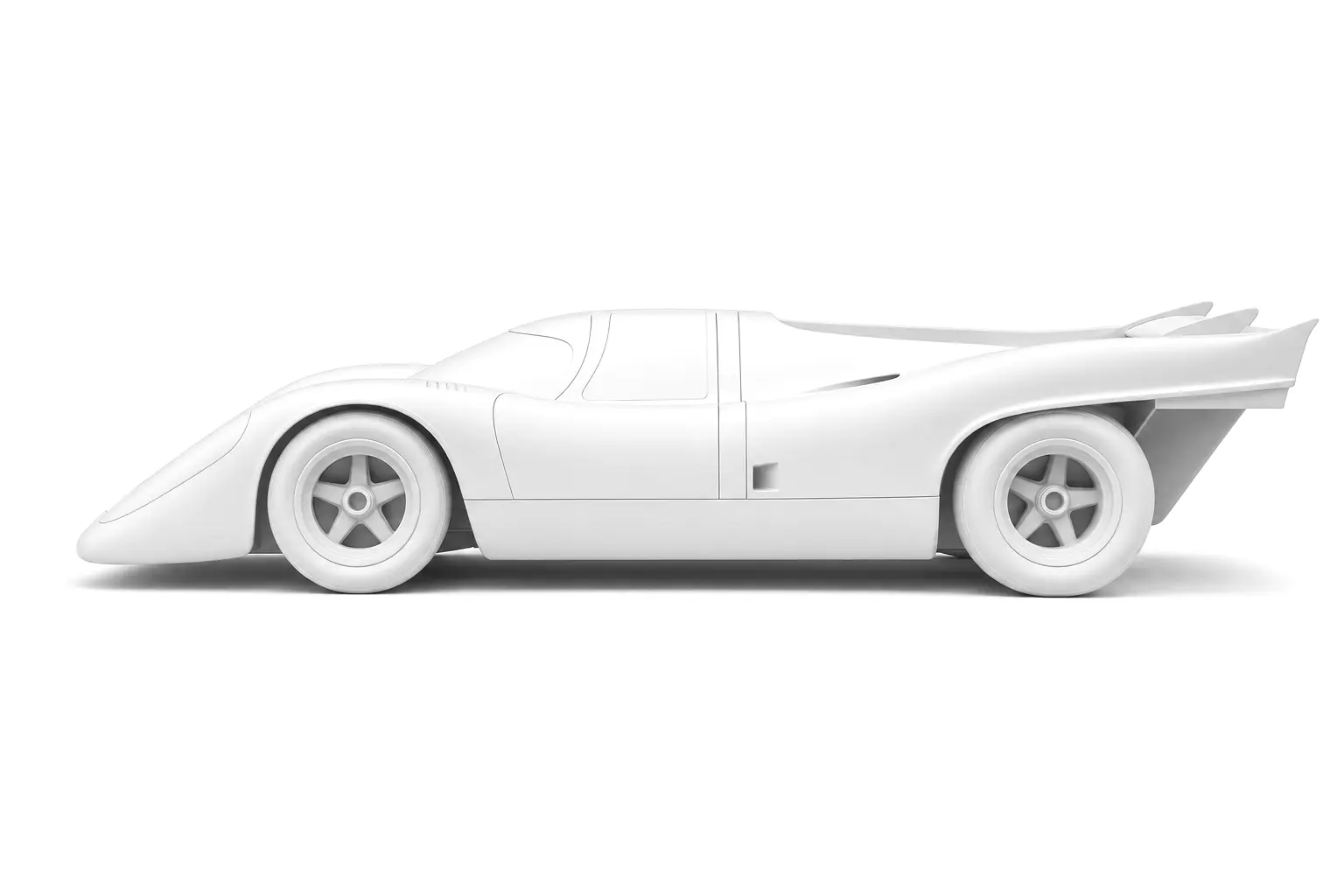
White styling model of the Porsche 917 K short-tail coupé

1969–1971

Kurzheck

The short tail — the fix that won everything

The first 917 body was drawn for straight-line speed, and at racing speed it lifted — Brian Redman called it “incredibly unstable, using all the road”. The answer came at the Österreichring in October 1969, not from a wind tunnel: John Wyer’s engineer John Horsman read the dead flies on the panels — none behind the rear axle, where the air never touched the car — and had a shorter, upswept tail improvised overnight in aluminium sheet and tape.

Downforce where there had been lift. The Kurzheck carried both Le Mans victories and everything around them; it is the body the market means when it says “917”.

  • Upswept tail, improvised at Zeltweg in sheet and tape
  • Both Le Mans wins — 1970 and 1971
  • The definitive body: 36 of 59 chassis
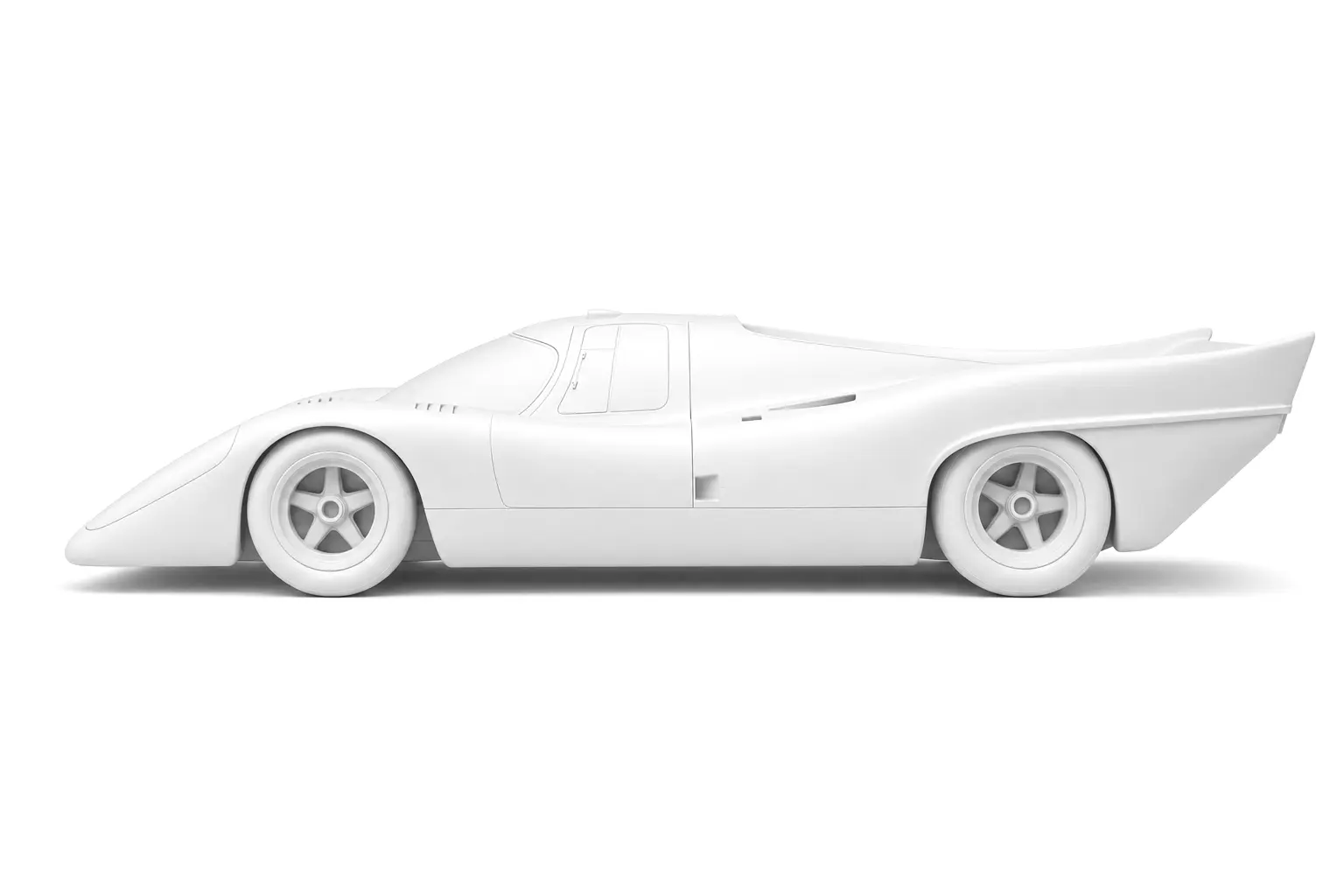
White styling model of the Porsche 917 LH long-tail coupé

1969–1971

Langheck

The low-drag body, built for one straight

The long tail existed for six kilometres of France. With SERA’s Robert Choulet, Porsche shaped a body for the Mulsanne: a tail stretching far past the rear wheels, rear arches partly enclosed, drag pared to the minimum stability would allow. In 1971 it was timed at 386 km/h — the fastest thing Le Mans had seen.

It never won there. The calm the Kurzheck bought with its blunt tail was exactly what the Langheck traded for speed, and the K did the winning while the LH set the records. Five were built; the works sold exactly one.

  • SERA / Robert Choulet low-drag development
  • 386 km/h on the Mulsanne, 1971
  • Five built — one ever sold
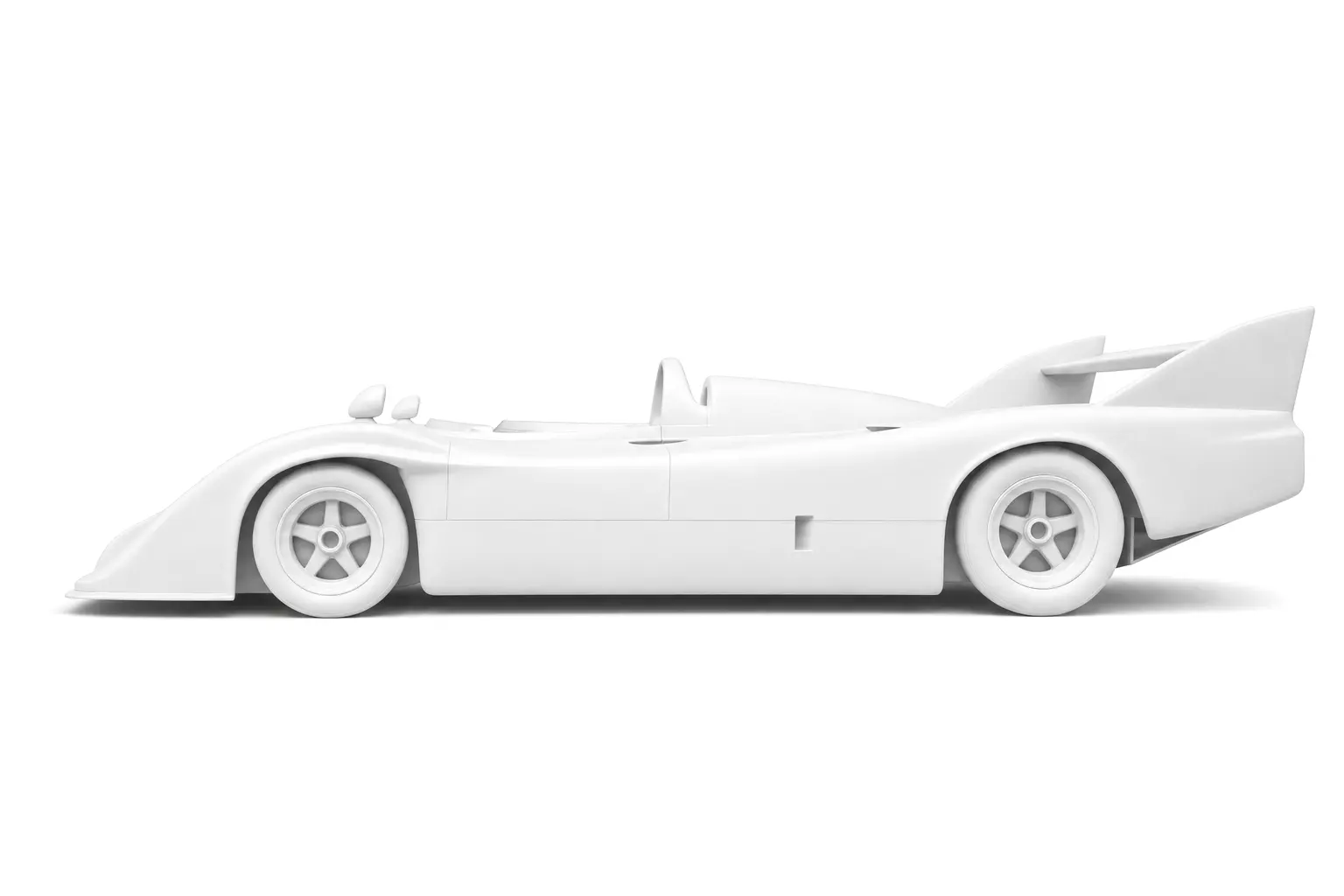
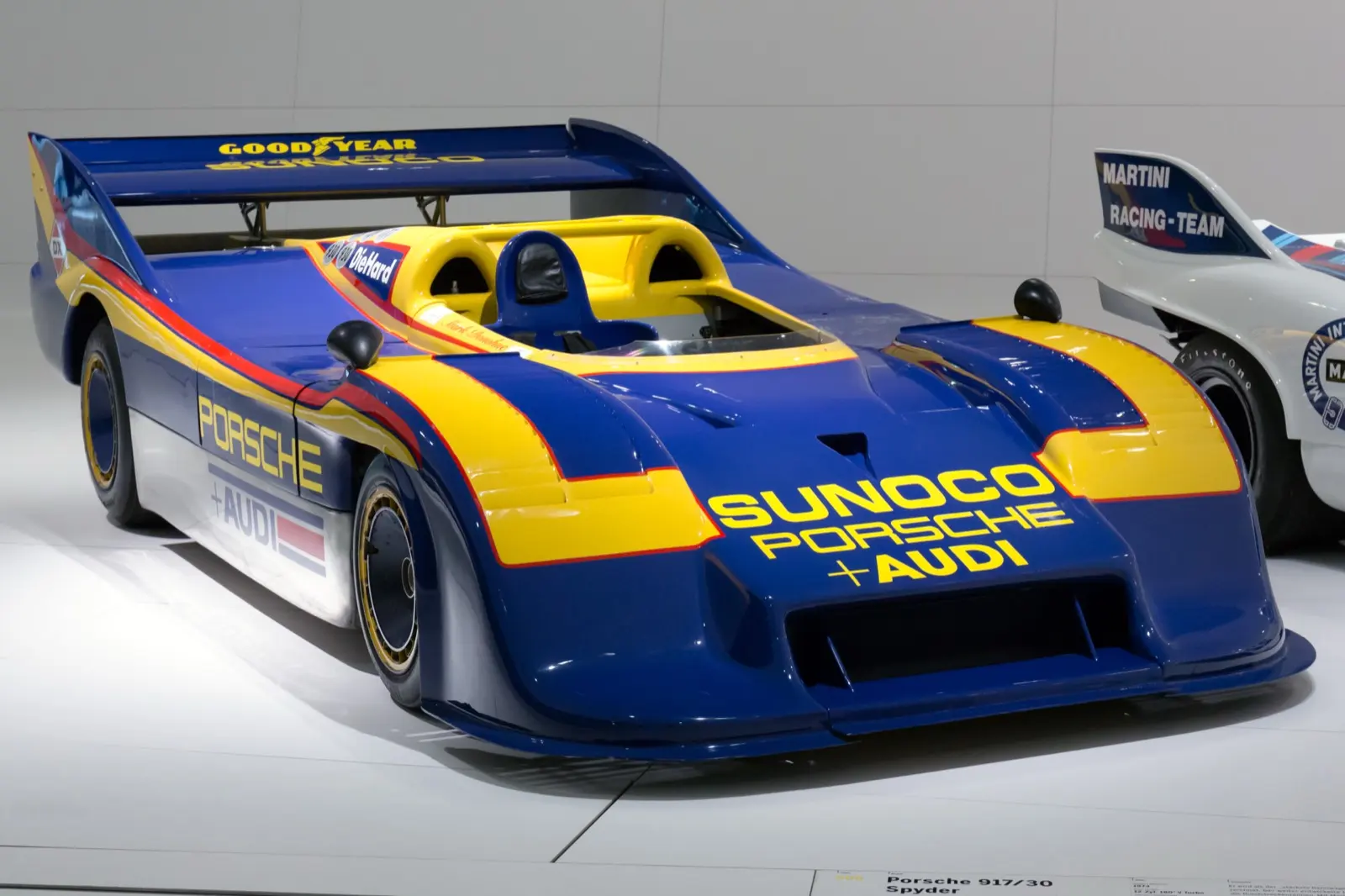
White styling model of the open Porsche 917/30 Can-Am spyder

1969–1973

Spyder

The open Can-Am body — roof and lights deleted

Can-Am ran sprints in daylight with almost no rulebook, so the roof, the doors and the headlights simply left the drawing. The 1969 PA Spyder tested the idea; the 917/10 hardened it into a blunt wedge with a broad, flat tail deck; and the turbocharged 917/30 stretched the form — longer nose, longer wheelbase, the wing carried between two fins.

In this body the 917 made its last and loudest argument: eleven hundred horsepower, back-to-back championships, and a series that folded rather than answer it.

  • Open cockpit — no roof, no lights, low screen
  • Wedge nose and finned tail deck on the turbos
  • Can-Am champion 1972 and 1973

True scale

Hip-high at 386

The numbers say 920 millimetres; the eye needs company. Against the two Ferraris and Porsches everyone knows, the 917 is not a car so much as a drawn line.

Porsche 917 K

4.14 m · 0.92 m high

Ferrari F40

4.36 m · 1.12 m high

Porsche 911 Carrera

4.52 m · 1.30 m high

1.80 m
0m1m2m3m4m5m6m7m8m9m10m11m12m13m

Nominal factory dimensions; silhouettes traced from styling models, so proportions are approximate. The figure stands 1.80 m.

The straight

0km/h

Six kilometres of public road, closed once a year. In 1971 the long-tail was timed at 386 km/h on the Mulsanne — a hundred metres every 0.93 seconds, for three and a half minutes a lap.

917 LH · Hunaudières straight · Le Mans 1971

0 km0.5 km1 km1.5 km2 km2.5 km3 km3.5 km4 km4.5 km5 km5.5 kmMulsanne — end of the straight

The variants

Ten 917s, not one

The badge is shared; the cars are not. From the Le Mans-winning Kurzheck coupes to the 1,100 PS Can-Am turbos, each variant trades in its own world, where it trades at all. Choose one and the page below reads in its colours: its file, its cars, its market.

917 K

1969–1971 · Works / very rare · 36 built

Porsche 917 K in Gulf blue and orange, head-on

Gulf

J.W. Automotive Engineering · 1970–1971

Both film cars — the $14.08M and $25M record chassis

The short tail that fixed the aerodynamics and won everything — both Le Mans victories, the distance record, the film cars. The variant the market means when it says “917”.

Born at the Österreichring in late 1969, when John Wyer’s engineer John Horsman read the dead flies on the bodywork — no smears on the tail meant no airflow — and improvised a shorter, upswept deck in aluminium and tape. Gulf/JWA and Porsche Salzburg ran the works campaigns; 1971 added the magnesium-framed 053, which won Le Mans and never raced again.

Open as its own file →
  • Le Mans winner 1970 (Herrmann/Attwood) and 1971 (Marko/van Lennep)
  • 1971 distance record — 5’335 km, unbeaten for 39 years
  • Both “Le Mans” film cars, 022 and 024, are Ks
  • Record: $14.08M for 917-024 — the most valuable Porsche at auction
Engine
4.5–5.0L flat-12 · Type 912
Power
580–630 PS
Weight
~800 kg

Typical value · K · Kurzheck

€13M

€2.0M€27M

The paper trail · K · Kurzheck

Documented cars
7 of 36 built
Top public sale
$25M
Private sale · 2025 — Solar Productions → Redman → Attwood → Seinfeld
Never traded publicly
4 of 7 documented
museum and long-hold cars
Latest movement
Private sale · 2025
Solar Productions → Redman → Attwood → Seinfeld
Open the register

59 works chassis, 1969-1973. Body-type counts vary by source; the Kremer K-81 of 1981 sits outside that count.

The cars

The 917 K register

Documented individual cars — chassis, colour, ownership and sale history. Open one for its full provenance. Public records only; members see the complete registry.

07 documented · public records

The works board

Fifty-nine tags

Every 917 left Zuffenhausen with a number, and almost every number has a story — raced, crashed, renumbered, hidden, sold. These are the files the register documents so far; the grey tags are open research.

Counts follow the works ledger (some tallies reach 65 with rebuilt frames). Grey tags: chassis documented only as built — files in research.64 tags

HICON BID

Buying interest, silently.

A HICON Bid is a confidential expression of buying interest on the Porsche 917 file — never public, never shown to other members. It is not a binding purchase, and HICONIUM holds no funds.

Sign in

HICON Bids are a member instrument. Sign in to place one.

The vault

Open a file on yours.

You keep one? The record starts in your garage — identity, papers, photography, and the market evidence this file already carries, bound to your chassis.

The value drivers

What moves the price

Two 917s can look identical in a photograph and twenty million apart at the hammer: the file decides. These are the documented attributes the market pays for — and the ones it discounts.

Indicative band · the base car

$12M$20M

a good, honest road car — before its file is read

$5.0M$70M

Spans are indicative, drawn from the documented sales cited beside each attribute. The calibrated multipliers — and how they compound for one specific chassis — are member instruments.

The x-ray

Anatomy of $14 million

Two 917s can be identical in aluminium and twenty million apart in paper. Layer by layer, this is what the record price of 917-024 was actually buying.

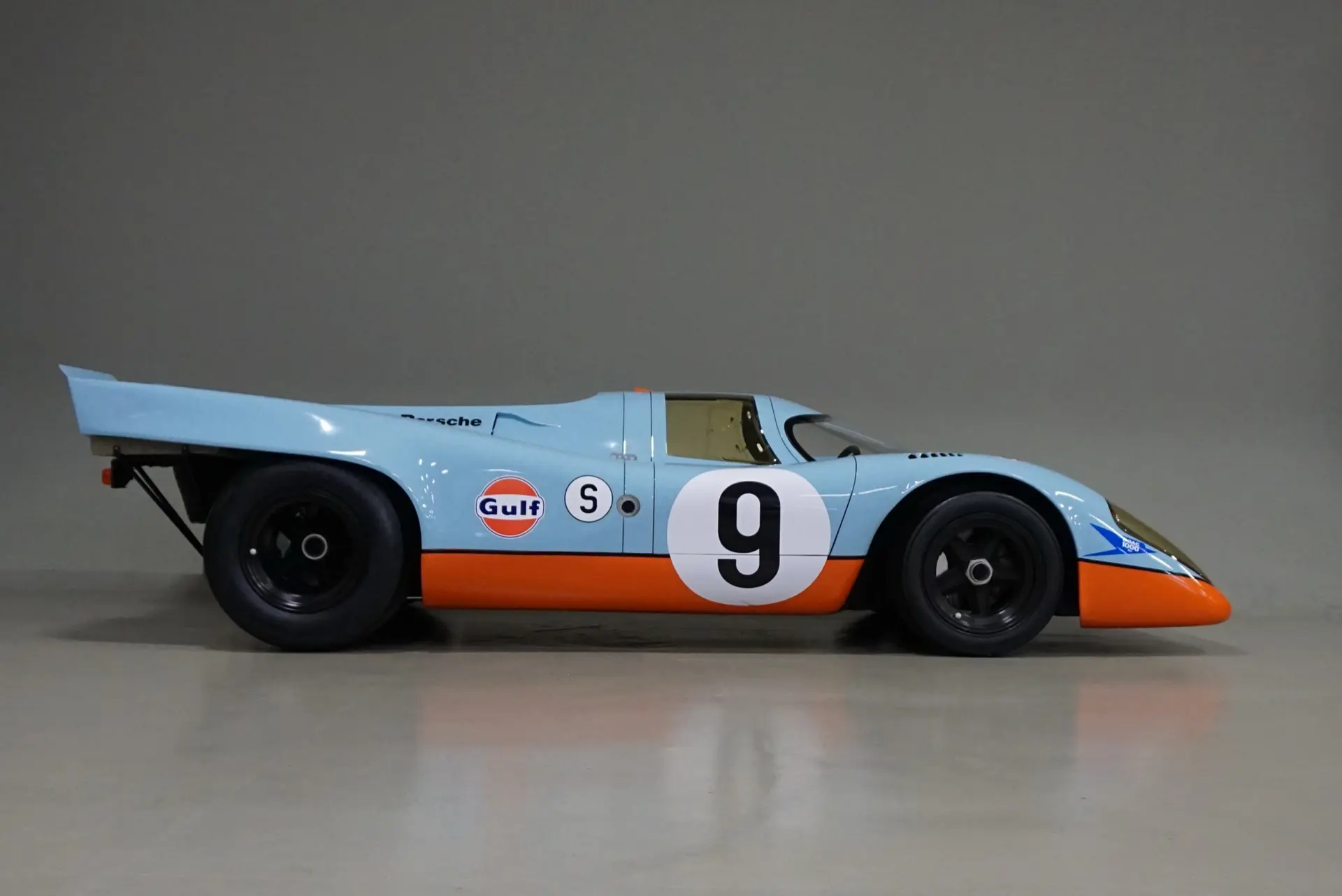
A Gulf 917 K in profile (illustrative photograph)
$14 080 000Gooding & Company · Pebble Beach 2017 · 917-024

Editorial weighting for reading, not measured data — the market prices the whole file at once.

The identity files

Numbers that moved

Racing chassis were equipment, not heirlooms: numbers moved with customs papers, insurance claims and rebuilds. Reading a 917 begins with reading past its plate — three documented cases from the register.

917-026917-031

Le Mans 1970 → 1971

Hailwood crashed the Gulf car at Le Mans; JWA rebuilt it around a works spare frame and, for customs, kept the old number. The rebuilt car raced on as 026 — while the original frame went home to the works and came back as a spyder wearing 031.

917-020917-023

The Polak years

US dealer Vasek Polak at times held both cars, and restorations in his shop swapped their identities — a tangle the registry notes on both files to this day.

917-043917-044

Pebble Beach 1998

The psychedelic “Hippie” long-tail was catalogued and sold as one chassis while the literature argues it is physically the other — the only complete LH the works ever sold carries the argument in its file.

Heritage · Porsche 917

Finished. Thanks for staying together.

Steve McQueen’s note, left on 917-022 · 1970
Porsche 917 K in Gulf livery, head-on
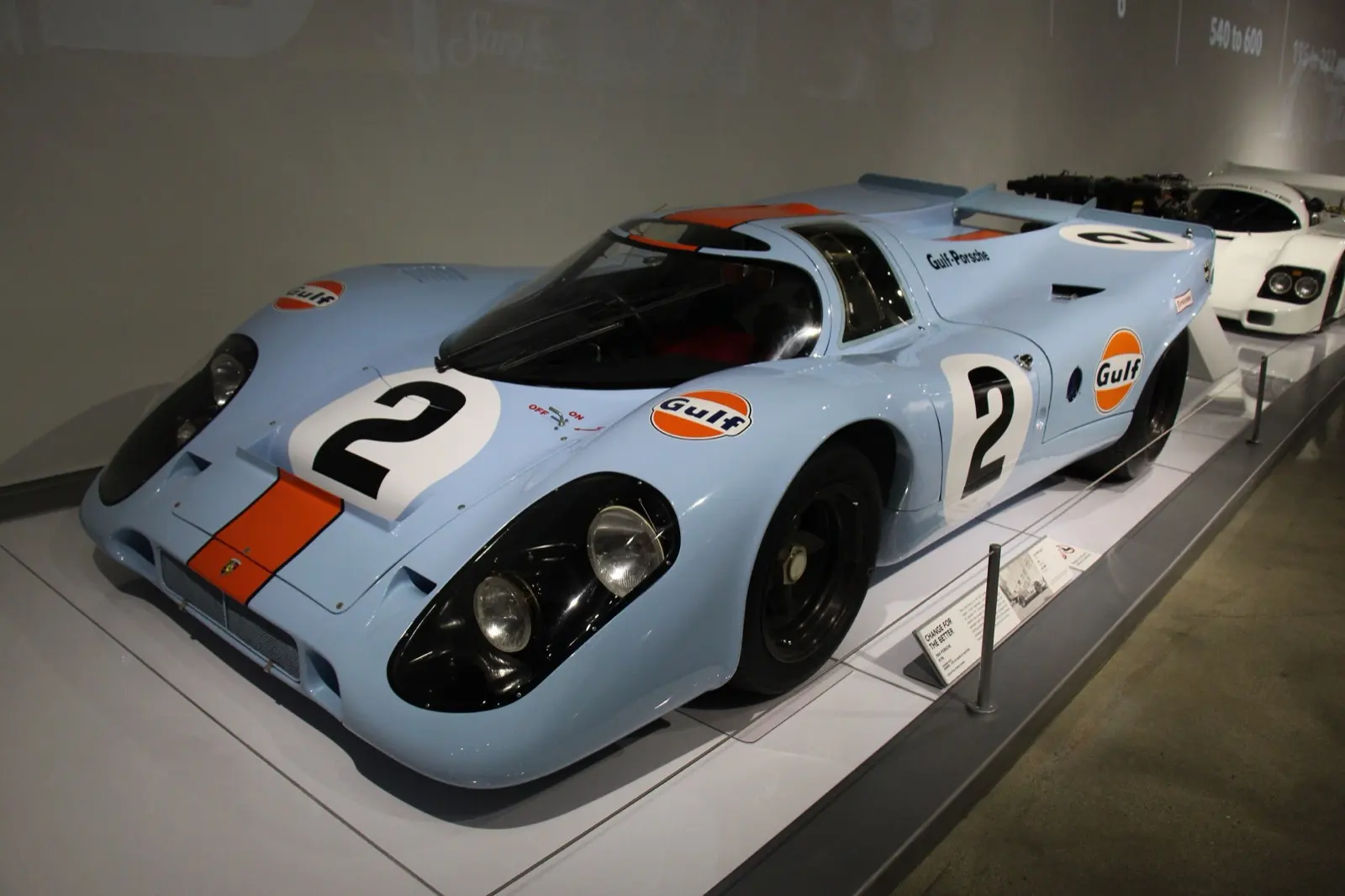
Porsche 917 K in Gulf livery, museum three-quarter view

1968 · The rule

Twenty-five cars

It began as an accounting decision by the rule-makers. In April 1968 the CSI lowered the number of cars needed to homologate a five-litre sports car from fifty to twenty-five, and Ferdinand Piëch — thirty-one years old, running development, spending money the company would only later admit to — decided Porsche would simply build them all. The decision fell in July 1968. The car was on the Geneva stand the following March, priced at DM 140’000: roughly ten 911s, and still a loss on every chassis.

The inspectors came in the spring and found three cars finished, eighteen half-built and seven in boxes. Porsche argued they would all be stripped for racing anyway; the CSI walked away. So on 20 April 1969 all twenty-five stood in line in the works courtyard, and Piëch invited the officials to drive whichever they liked. They declined, signed, and the 917 existed.

The hands

Three men, one gamble

The 917 had many fathers; three signatures matter most — the man who ordered it built, the man who drew its engine, and the man who fixed its tail with sheet aluminium and tape.

Ferdinand Piëch

Head of development · the gamble

Read the 1968 rule change as an invitation, ordered twenty-five cars built at once, and spent money the company would only later admit to. The 917 is his answer to what Porsche was willing to risk.

Hans Mezger

Konstrukteur · the Type 912 flat-12

Drew the air-cooled 180-degree twelve — 520 PS in 1969, 1’100 turbocharged — and the car around it. The engine is why the 917 could be outlawed but never beaten.

John Horsman

J.W. Automotive · the Kurzheck

Read the dead flies on the bodywork at Zeltweg — no smears on the tail meant no airflow — and improvised the short tail overnight. The 917 K that came out of it won everything.
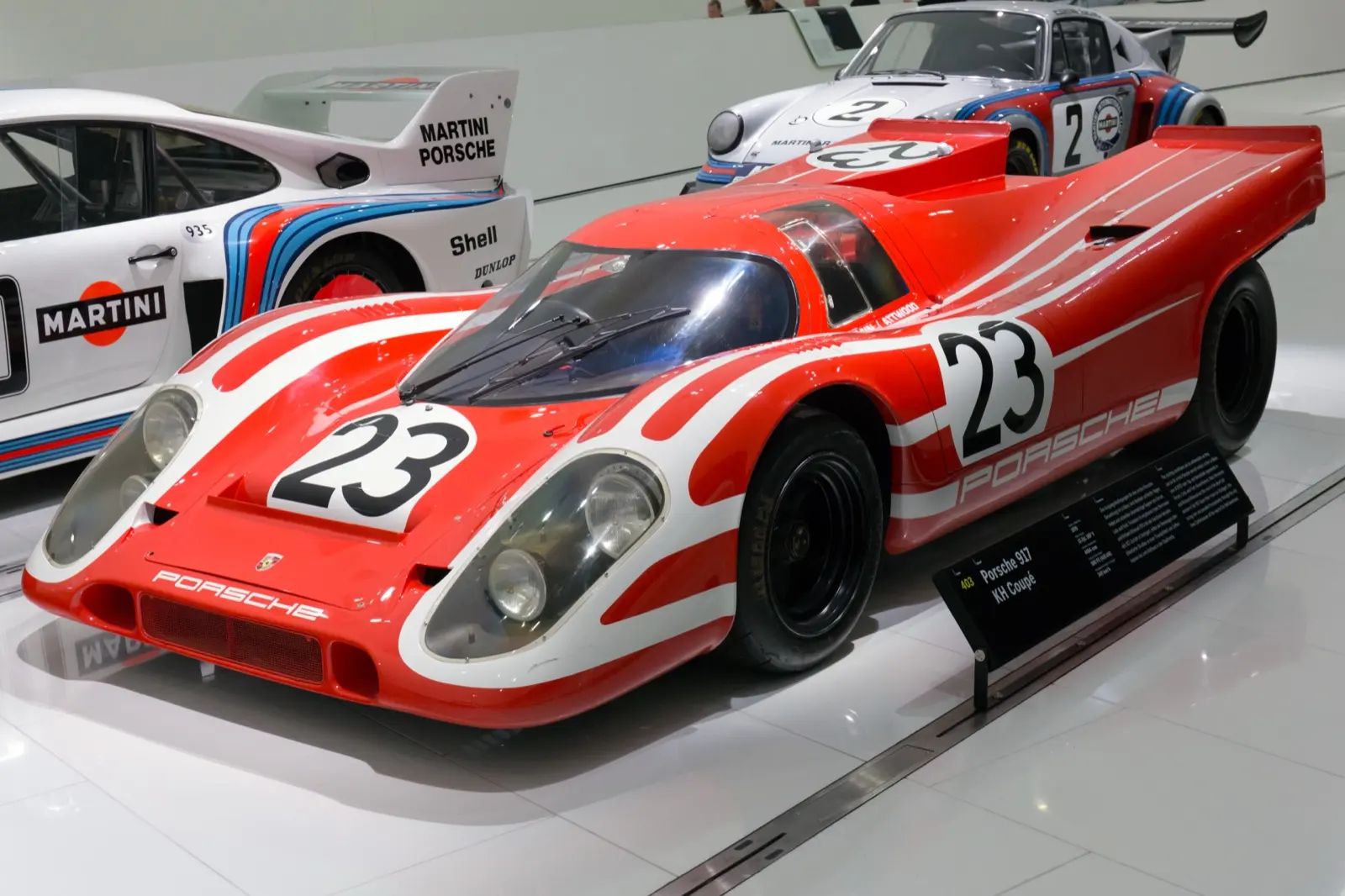
The 1970 Le Mans-winning Porsche 917 K in Salzburg red and white
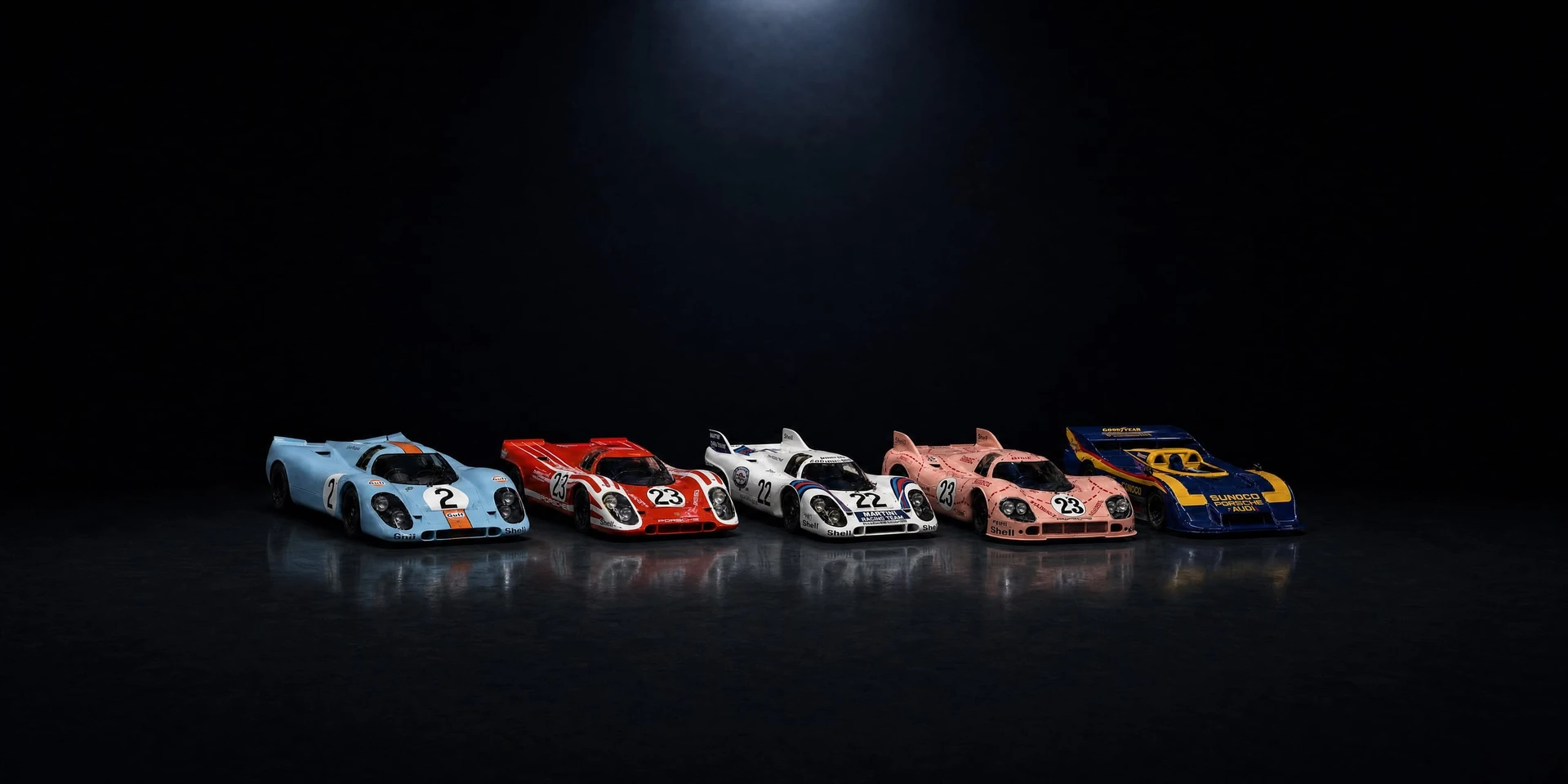
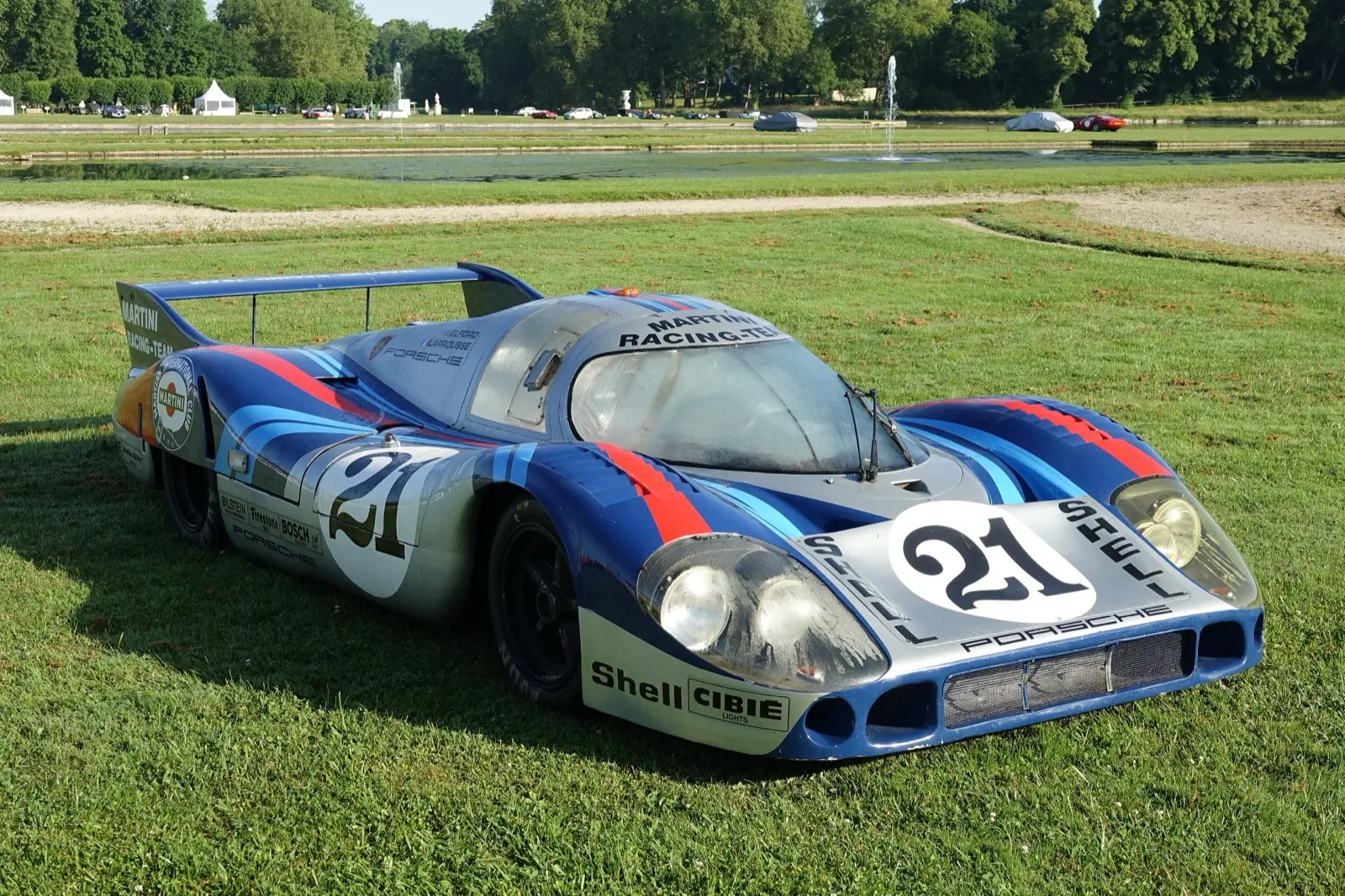
Porsche 917 LH long-tail in Martini livery

1969 to 1971 · The fix

The taped-up tail

The first 917 was fast and nearly undriveable. The long tail generated lift; Brian Redman called it “incredibly unstable, using all the road at speed”, and works drivers quietly preferred the old 908. The answer came not from the wind tunnel but from an observation at the Österreichring: John Horsman, John Wyer’s engineer, noticed the dead flies on the bodywork stopped short of the tail. The air never got there. A shorter, upswept tail was cut from aluminium sheet, taped on overnight — and the 917 K was born.

What followed was the most complete domination sports-car racing had seen. In 1970 Hans Herrmann and Richard Attwood brought the red-and-white Salzburg K home through the rain for Porsche’s first outright Le Mans win. In 1971 the white Martini K of Helmut Marko and Gijs van Lennep — its frame in magnesium — covered 5’335 kilometres at an average of 222 km/h, a distance no car would beat for thirty-nine years. Down the Mulsanne, the long-tail LH was timed at 386 km/h.

1971

13 June 1971

The distance record

Marko and van Lennep’s magnesium-framed K covers a distance no Le Mans winner will match until 2010. The car is retired on the spot.

Thirty-nine years untouched — the deepest engineering flex in the file.
Porsche 917 K in Gulf livery from above
The spartan right-hand cockpit of a Porsche 917 prototype

The myth

Blue and orange

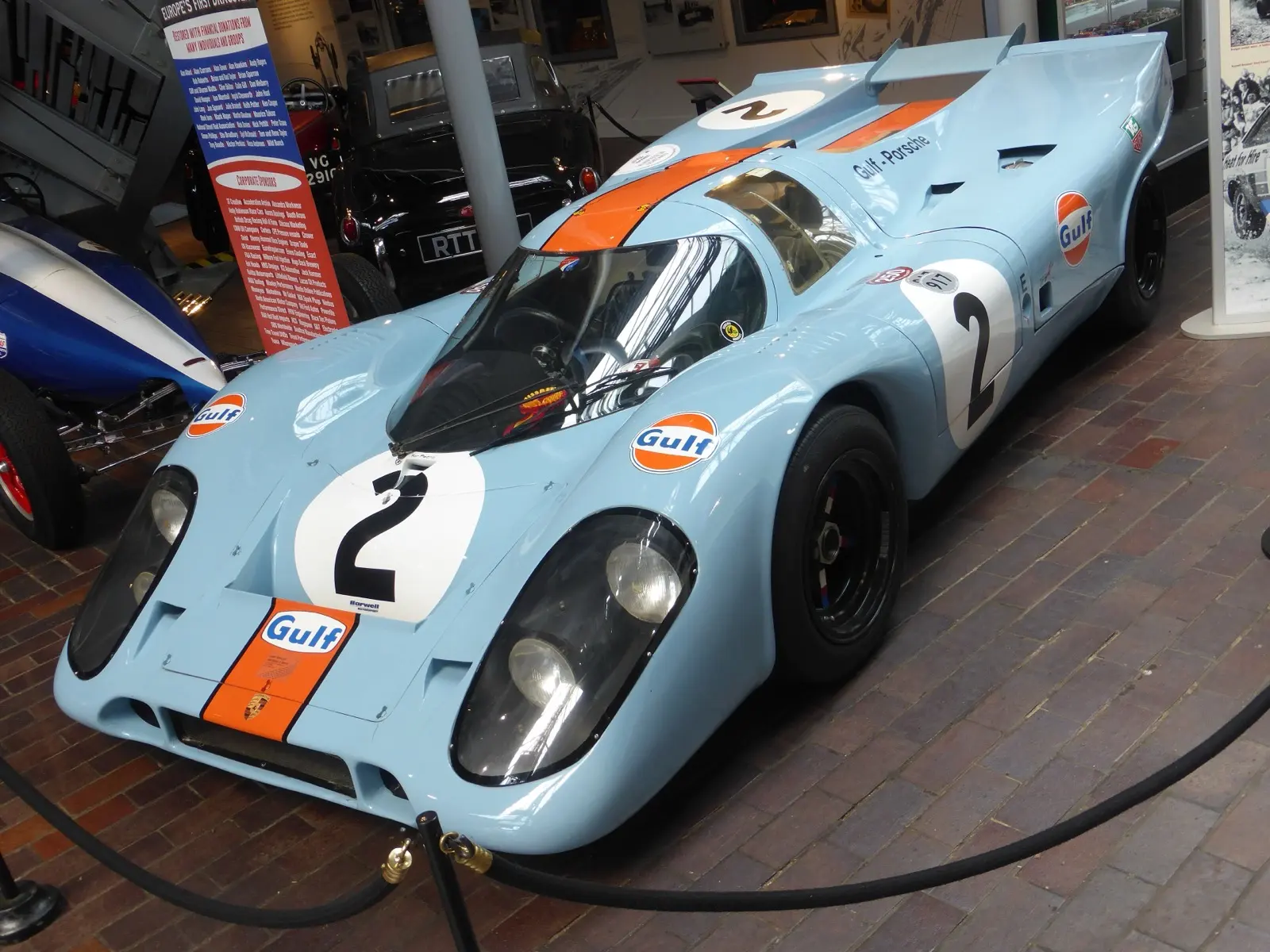
The factory’s racing was run through John Wyer’s Gulf-backed team, and the pale blue and orange of Gulf Oil became the colour the car is remembered in — helped by a film. Steve McQueen had wanted to race Le Mans himself in 1970; the insurers said no, so he filmed it instead. Solar Productions leased Jo Siffert’s 917-024, bought 917-022 outright, and shot “Le Mans” in and around the 1970 race. The film lost money, McQueen left the project bruised — and the car got the most valuable advertisement in motorsport history.

The market took fifty years to catch up. Brian Redman bought the hero car for 15’000 dollars in 1975. The same chassis made 1.32 million in 2000, entered the Seinfeld collection, and in January 2025 drew a bid of 25 million dollars at Kissimmee — declined, then settled privately in the same range. Its sister film car, 024, slept over two decades in a warehouse outside Paris before selling for 14.08 million in 2017: still the most valuable Porsche ever sold at auction.

On the record

Milestones, on a line

The moments that set the 917's standing. Use the arrows, and hover a point to read what happened.

1969Geneva revealDM 140'000, ten 911s
1969Twenty-five in the courtyardHomologation, the hard way
1970Le Mans, wonHerrmann / Attwood · 917-023
1971The distance record5'335 km at 222 km/h
1971“Le Mans” premieresMcQueen, Gulf blue, a flop
1972Banned at its peakThe five-litre class closes
1973Can-Am, crushed917/30 · 1’100 PS
2017The $14M Porsche917-024 at Pebble Beach
2025$25 million, declinedThe McQueen car at Mecum

March 1969

Geneva reveal

Eight months after the decision, the 917 stands at the Geneva Salon — at a price that does not begin to cover the car.

The gamble is public: a grid of prototypes built to a loophole.

20 April 1969

Twenty-five in the courtyard

All twenty-five cars line up outside Zuffenhausen. Piëch invites the CSI inspectors to drive any of them; they decline and sign.

The photograph of the line-up is the founding document of the legend.

14 June 1970

Le Mans, won

In pouring rain the red-and-white Salzburg 917 K takes Porsche’s first outright Le Mans victory — 343 laps, 4’607 km.

The win the whole programme was built for; the winning car never sold.

13 June 1971

The distance record

Marko and van Lennep’s magnesium-framed K covers a distance no Le Mans winner will match until 2010. The car is retired on the spot.

Thirty-nine years untouched — the deepest engineering flex in the file.
June 1971

“Le Mans” premieres

The film loses money on release — and fixes the 917 in Gulf blue and orange in the public imagination for good.

Fifty years on, film provenance is the strongest value driver money can actually buy — the winners never trade.
1972

Banned at its peak

The rules that created the 917 are rewritten to end it. Porsche ships the programme to America instead.

Scarcity by decree: no more were needed, so no more were built.

1973

Can-Am, crushed

Donohue wins the last six rounds; McLaren has already left. After a fuel rule ends the turbos, the series itself folds.

The only car to have killed a championship by winning it.
18 August 2017

The $14M Porsche

The ex-Siffert film car, found in a Paris warehouse after two decades, sells for $14.08M — the most ever paid for a Porsche at auction.

The record that still stands; provenance did all the lifting.

18 January 2025

$25 million, declined

Bidding on 917-022 reaches $25M; Seinfeld lets it fail, then sells privately “in the $25 million range”.

The ceiling of the Porsche market, set and not yet cleared.
16:0021:3003:0016:00
51 cars started

The race

Le Mans 1970 — the first one

Fifty-one cars started; the rain decided who mattered. Porsche Salzburg’s №23 — the red and white 917 K of Hans Herrmann and Richard Attwood — drove around the chaos for a day.

16:00Start

Fifty-one starters, eleven of them 5-litre prototypes. The 917s of Elford and Siffert set the early pace.

7 of 51

Classified

4 607.811 km

Distance

191.99 km/h

Average

343 laps

Course

Herrmann / Attwood · 917-023 · Porsche Salzburg

917 K in Gulf colours, Petersen Museum
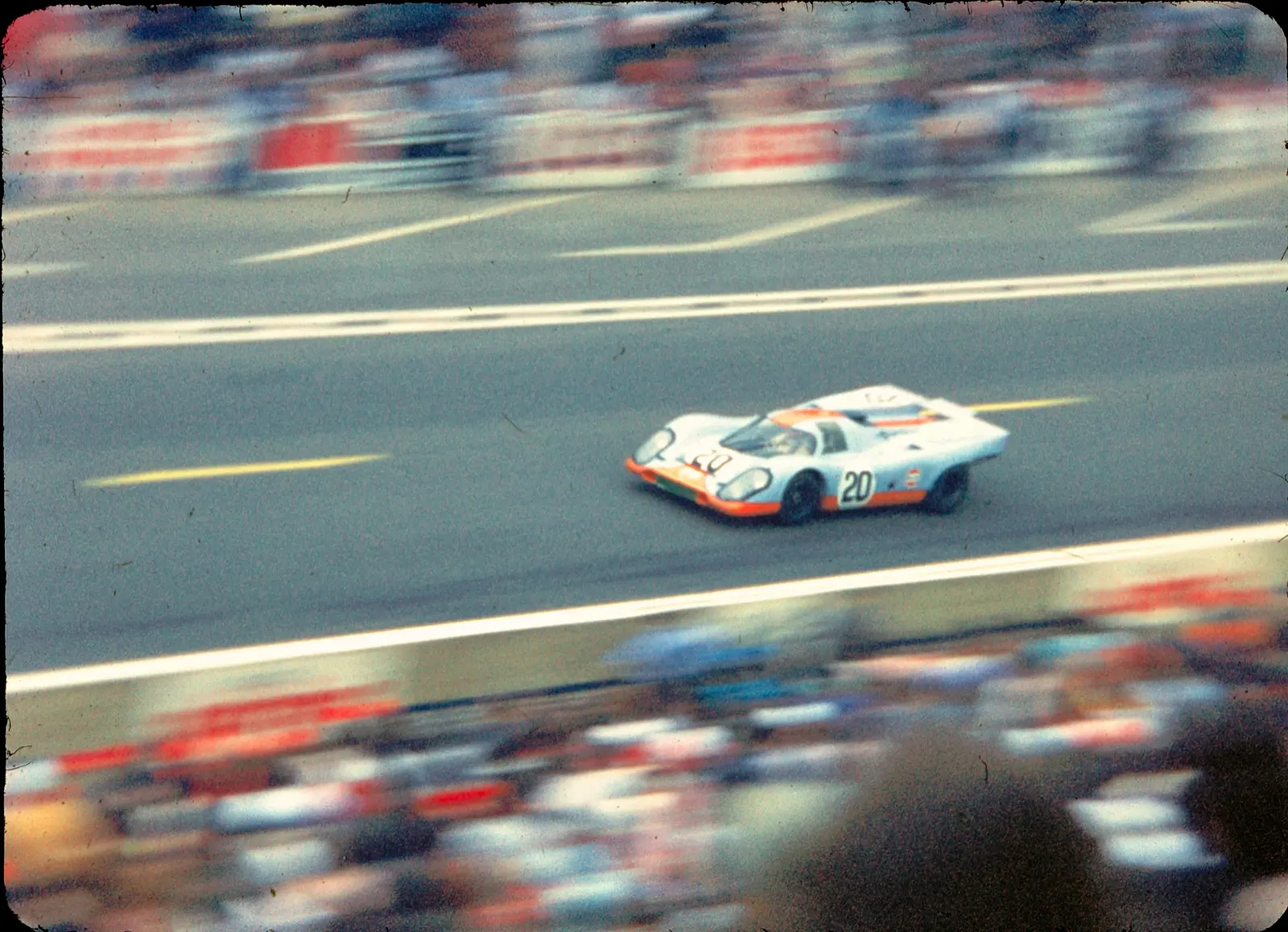
The Gulf 917 K at Le Mans, 1970 — period photograph
917 K Gulf, Porsche Museum

The ascent

Chassis 917-022

One chassis, fifty years

Chassis 917-022 — McQueen’s hero car — is the market’s own biography: every era priced it by what it believed a racing car was worth.

$15’000

A used racing car

Brian Redman buys the film hero car privately — obsolete equipment, fondly remembered.

USA · private

1975200020172025

Documented, sale by sale, in Market & Price.